Appearance
Agent Teams (Experimental Release, Feb 2026) — Peer Collaboration Beyond Sub-Agent
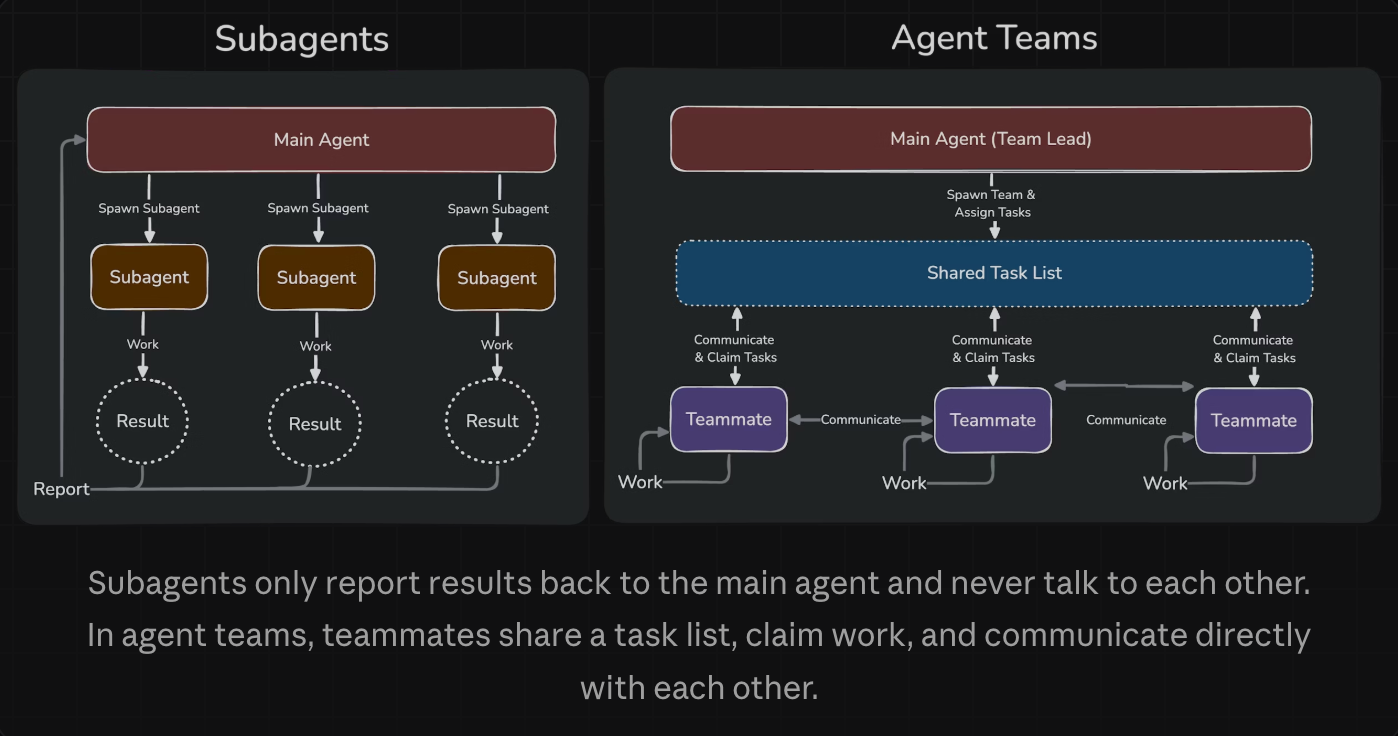
Agent Teams extend the sub-agent model with direct peer-to-peer communication. Instead of sub-agents only reporting to a supervisor, teammates can send messages to each other, challenge each other's findings, and collaboratively converge on conclusions.
This is an experimental feature. Enable by setting CLAUDE_CODE_EXPERIMENTAL_AGENT_TEAMS=1 in your environment or settings.json.
Architecture Highlights: Zero Infrastructure, Pure File-Based Coordination
Core file paths and definitions:
~/.claude/teams/{name}/config.json← Member Registry~/.claude/teams/{name}/inboxes/{agent}.json← Message Inbox~/.claude/tasks/{name}/{id}.json← Task Card
Coordination mechanism: Exclusive Lock = flock(), Message Delivery = JSON append, Task Dependency = blockedBy array.
Unix Philosophy Insights
"The most mature multi-Agent production systems today use JSON files and flock() for coordination." "If your Agent orchestration requires a message queue, you have already over-engineered it." Get the implementation right with the file system first, then consider whether to adopt Kafka.
Git Worktree Isolation — Each Agent Gets an Independent Code Copy
- Isolation logic:
worktree→ Auto-create git worktree branches - No conflicts even when multiple Agents modify the same file simultaneously
- Auto-cleanup of the worktree when no modifications are made
Core Components
| Component | Role |
|---|---|
| Team Lead | Main Claude Code session. Creates the team, generates and assigns tasks, synthesizes results, and closes the team when done. |
| Teammates | Independent Claude Code instances with individual context windows. Pick up tasks from the shared task list. |
| Task List | Shared queue at ~/.claude/tasks/{team-name}/. Tasks carry pending / in_progress / completed states and can declare dependencies. When a dependency completes, blocked tasks auto-unlock. |
| Mailbox | Point-to-point message and broadcast communication. Broadcasts cost tokens proportional to team size — use sparingly. |
Important: Teammates do not inherit the lead's conversation history. They receive only their spawn prompt. Provide all necessary context upfront: project structure, constraints, tools available, target deliverables, and output templates.
Sub-Agents vs Agent Teams
- Sub-Agent: One-way master-to-subordinate delegation, compressed result return, optimized for scenarios with clearly defined division of labor.
- Agent Teams: Peer-to-peer communication, shared task board, self-coordination, optimized for exploratory tasks.
| Sub-Agents | Agent Teams | |
|---|---|---|
| Communication | Report to supervisor only | Peers can message each other |
| Coordination | Centralized (supervisor) | Distributed (peer-to-peer) |
| Use case | Parallel execution, result reporting | Collaborative investigation, debate |
| Token cost | Moderate | High |
| Complexity | Low | High |
| Best for | Pipeline workflows, noisy operations | Competing hypotheses, multi-angle review |
One-line decision rule: Workers don't need to talk to each other → Sub-Agents. Workers need to discuss and challenge → Agent Teams.
Collaboration Patterns
Competing Hypotheses
Use when: Root cause is unclear, multiple theories exist, and single-investigator anchoring bias is a risk.
How it works:
- Assign each hypothesis to a separate teammate
- Require teammates to actively try to disprove each other's theories, not just validate their own
- The surviving hypothesis — one that explains all observed symptoms and withstands challenge — becomes the conclusion
Example: A cascading failure with three reported symptoms (session loss, API slowdown, data leak) might stem from 4 interconnected bugs: a too-small DB connection pool, Redis session not handling reconnects, an N+1 query in order fetching, and a cache race condition without user isolation. Assign a "session detective," "database detective," "cache detective," and "architecture detective" as teammates. Each investigates independently, shares findings, and challenges the others.
Why it works: Avoids the common failure of "find one plausible bug and stop." The debate mechanism filters weak hypotheses and surfaces the complete cascade.
Best for: Production incidents, complex performance regressions, any failure with multiple interacting causes.
Parallel Review (Multi-Angle Code Review)
Use when: A PR or code change needs evaluation across independent dimensions.
Typical setup:
- Security reviewer: vulnerabilities, input validation, authentication
- Performance reviewer: complexity, resource usage, query efficiency
- Test reviewer: coverage, edge cases, regression risk
Each reviewer works in parallel. Cross-dimension issues (e.g., a security flaw that also degrades performance) surface through teammate communication.
Why it works: Single reviewers inevitably weight some dimensions over others. Dedicated reviewers per dimension ensure nothing is systematically ignored.
Module Ownership
Use when: A feature spans multiple modules (frontend, backend, DB, tests) and parallel development would otherwise create conflicts.
Key mechanisms:
- Task dependencies: Tasks declare prerequisites; downstream tasks unlock only after upstream tasks complete (e.g., tests wait for implementation)
- File ownership: Each teammate owns a non-overlapping set of files; shared interface files are handled by a single designated teammate
- Auto-unlock: Dependency completion automatically makes blocked tasks available for pickup
Why it works: Achieves parallel development without merge conflicts, by separating ownership by file boundary rather than attempting concurrent edits.
Plan Approval
Use when: High-risk tasks — authentication refactor, schema migration, core service rewrite — require design review before implementation.
Workflow:
- Architect teammate produces a plan — documentation and approach, not code
- Lead evaluates the plan against predefined approval criteria
- Only approved plans proceed to implementation
Define approval criteria in the lead's prompt, for example:
- "Approve only plans that include a test plan."
- "Reject any plan that modifies the database schema."
Why it works: Makes "think before you code" a hard constraint, not a suggestion. Prevents a large class of expensive rework caused by wrong-direction implementation.
Best Practices
Team Design
- Provide full context upfront. Teammates start with only their spawn prompt. Include project structure, constraints, available tools, goals, and any output templates they need.
- Right-size tasks. Too small: coordination overhead exceeds parallelism benefit. Too large: long "black box" periods with no checkpoints. Target 5–6 tasks per teammate, each with a concrete deliverable (a function, a test file, a report).
Conflict Control
- Prevent file conflicts. Assign non-overlapping file sets. Designate a single owner for shared interface files; establish the interface contract first before parallel implementation begins.
- Supervise actively. Don't let teams run unsupervised for long stretches. Check progress, inject new tasks when cross-teammate coordination is needed, and redirect drifting teammates.
- Pace the lead. Use explicit instructions when necessary: "Wait until all teammate tasks are complete before synthesizing and proceeding."
Getting Started
Begin with read-only, no-write scenarios: bug investigation, technical research, PR or design doc review. These have clear boundaries, obvious collaboration value, and no parallel-write conflicts. Graduate to Module Ownership and Plan Approval as your coordination skills develop.
Performance and Cost
Multi-agent systems carry compounding overhead:
| Cost Factor | Impact |
|---|---|
| Token amplification | ~15x vs single-agent conversation |
| Per-dispatch overhead | Context load + execution + result return per agent call |
| Inter-agent communication | Grows with team size and message frequency |
| Debugging complexity | Non-deterministic decisions require full production tracing |
| Deployment risk | Can't stop mid-execution without losing work; requires progressive rollout |
When the cost is justified:
- Tasks where parallel exploration has clear quality gains — incident investigation, multi-hypothesis debugging, multi-angle design review
- High-complexity, high-value work where a large quality improvement justifies the token cost
- Organizational separation where teams need independent, maintainable agent capabilities
Golden rules:
- Start single agent. Upgrade only on concrete architectural bottlenecks.
- Add tools before adding agents. Tools are the minimum unit of capability extension.
- Choosing the right model beats adding more tokens.
- Multi-agent's core value is context isolation and parallel execution — not architectural complexity for its own sake.
- The best architecture is the simplest one that solves the problem.