Deconstructing Palantir Ontology: When an Ontology Moves From “Describing the World” to “Driving It”
Last updated: 2026-07-18
Written for engineers, technical architects, and technical decision-makers. About 9,000 words; by the end you’ll understand exactly what Palantir has turned “ontology” into.
A reading convention: this article makes a lot of quantitative claims. Wherever I cite a specific number, I tag the strength of the evidence — [Official] = Palantir marketing or self-reported documentation, [Competitor] = a competitor’s position, [SAP] = a source biased toward the SAP ecosystem, [Independent] = third-party / academic / verifiable evidence, [Unverified] = lacking publicly verifiable data. Read with these tags in mind — doing so is itself part of understanding the Palantir narrative.
Large language models can already write poetry, write code, and pass the bar exam. But would you dare let one independently approve a million-dollar cross-border wire transfer?
Almost everyone’s first reaction is “no.” The reasons aren’t hard to spell out. LLMs hallucinate — they’ll confidently fabricate facts that don’t exist. They’re uncontrollable — ask the same question twice and the reasoning paths can diverge wildly. And they’re unauditable — when something goes wrong, you can’t answer “why did we let this through?” In fault-tolerant settings like writing or translation, these flaws are harmless. But the moment you step into law, medicine, finance, or production scheduling — high-value, heavily regulated domains — they become fatal.
The industry’s answer has been remarkably uniform: put a “semantic cage” around the AI — constrain it with structured domain knowledge so that every step of its reasoning and every output runs inside a predefined business framework. That cage is what everyone calls an “Ontology.”
Here’s the problem: when five people say “we’re adopting an ontology,” they probably mean five different things. One means the logically rigorous OWL standard from academia; another means the knowledge-graph schema behind a search engine; a third means the “semantic layer” in a data platform; a fourth means the underlying consensus for multi-agent coordination. Same word — each person has hold of a completely different part of the elephant, yet each is convinced they’ve grasped the whole thing.
What this article sets out to do is focus on the most “heretical” of these — Palantir Ontology — and take it completely apart. Its distinctiveness, in one sentence: OWL lets machines understand the world, knowledge graphs let machines retrieve the world, and Palantir’s ontology lets machines change the world within the rules you’ve drawn, and evolve along with it. We’ll go layer by layer in the order Why (why it emerged) → What (what it actually is and how it differs from traditional ontologies) → How (how it’s implemented and built), and then close with a sober look at its costs and controversies.
Prefer slides? The whole argument is also available as a deck:
1. Why: Why Enterprises Need a “Third Kind of Ontology”
The “runaway” nature of LLMs forced an engineering version of ontology into being
First, let’s drag “ontology” out of its philosophical context. In philosophy it asks “what truly exists”; but in an engineering context it’s something very concrete: a semantic schema for a domain — a structured, precise description of that domain’s concepts, relationships, and rules.
Take an example. An ontology for e-commerce risk control has to spell out at least three things explicitly:
- Concepts: what a “user” is, what “risk” is, what an “order” is;
- Relationships: user → places → order;
- Rules: any order over 100,000 in value must go through risk-control approval.
Once these three are fixed in a structured form, no matter how clever an LLM is it can only reason and produce output inside that framework. Wants to “improvise” and skip risk control? Sorry — the rules won’t allow it. That’s the literal meaning of the “semantic cage”: using deterministic knowledge to put a bridle on a probabilistic model.
The real root cause: semantic fragmentation
But LLM hallucination is only the surface symptom. The deeper root cause lies in how enterprise data is organized — semantic fragmentation.
A large enterprise’s data lives across dozens or hundreds of systems: ERP, CRM, MES, data warehouses, Excel. The same “customer” is called KNA1 in SAP, Account in the CRM, and dim_customer in the warehouse — three names, three definitions. The fatal flaw of relational databases is this: they store “facts” but know nothing about the meaning between those facts. A flat, wide table is, to a machine, nothing but a pile of semantics-free strings — it doesn’t know that the field KUNNR represents a “customer entity” that can place orders, default, and be frozen, let alone that this customer and a particular row in the order table are two sides of the same thing.
So enterprise AI adoption gets stuck at four hurdles, each a direct consequence of semantic fragmentation:
| Challenge | Symptom | Root Cause |
|---|---|---|
| Semantic gap | The same concept is expressed differently across ERP/MES/CRM; AI can’t understand it uniformly | Each system defines its own terms with no unified semantic layer |
| Model hallucination | Random generation, black-box reasoning, may “confidently” violate rules | No deterministic knowledge constraining probabilistic output |
| Execution gap | AI can spot problems but can’t act on them automatically — “sees it, can’t fix it” | Analytical systems and operational systems are inherently siloed |
| Difficult knowledge retention | Expert experience is trapped in people’s heads; each AI app fights alone | No vehicle to turn tacit experience into a digital asset |
Of the four, the deadliest is the third — the execution gap. It’s also the entire reason Palantir exists.
Describe the world, or change it?
OWL and knowledge graphs, however rigorous their logic or vast their scale, all end at “answering a question” — understanding a piece of knowledge, retrieving a relationship. They describe the world but don’t change it.
An enterprise’s real pain is precisely the step after description: you’ve analyzed that “this machine needs servicing” — and then what? Someone still has to manually switch to the work-order system, fill in a form, and dispatch the job. Between data insight and business action lies a gap. Traditional BI is doomed to produce a pile of “beautiful-looking” dashboards and then stop there, waiting for a human to translate insight into action.
Palantir’s official document Why create an Ontology? pushes this stance to its logical extreme: an ontology is not for representing data, but for representing decisions (representing decisions, not data). [Official] This is a philosophical turn. Traditional data modeling asks “what entities and relationships exist in the world,” whereas Palantir asks “what decisions do we want to make in this world, what do those decisions depend on, and how do they flow back after execution.”
Around this turn, Palantir proposes a “Decision Flywheel”: use data to make decisions → capture the decisions made (write them back into systems, rather than letting them die in emails and static reports) → use data to evaluate the decisions’ impact over time → feed the next decision. [Official] Every decision is recorded in a structured way, forming “Decision Data” and a traceable “Decision Provenance.” Over time, the organization’s operational experience settles out of people’s heads and into the system, becoming a reusable, learnable asset. This is “decision-centric learning” — and it directly addresses the fourth hurdle, “difficult knowledge retention.”
write back to systems, not stuck in email & reports"] B --> C["Evaluate decisions
impact over time"] C --> A B -. accrue .-> D[("Decision Data / Decision Provenance")] D -. reuse & learn .-> A
So the conclusion of Section 1: an ontology isn’t a silver bullet — it’s a deterministic bridle placed on a probabilistic model. But what an enterprise truly needs to cross is the gap between “description” and “action.” Of the three kinds of ontology, only one is, from its very design, unsatisfied with “answering questions” and instead sets out to “drive decisions and learn from them.” That’s the distinction we’ll dissect next.
2. What (Part 1): How It Actually Differs From Traditional Ontologies
The previous section made the case for “why it was born.” This one places Palantir into the 40-year lineage of “ontology” to see clearly whether it’s a new variant of the same species, or a different species altogether.
A “naming dispute” with no losers
Academia has objections to Palantir’s use of the word “Ontology.” The classic definition comes from Tom Gruber’s much-cited 1993 line: an ontology is “an explicit specification of a conceptualization.” In that tradition, an ontology’s calling is to formally represent knowledge and support logical inference; it’s descriptive, aims for truth-consistency, and is independent of any specific application.
By that standard, Palantir’s “ontology” doesn’t qualify at all — it has no rigorous axiomatic system, no description-logic reasoner, and it even lets business users change the model by dragging and dropping. Hence the charge that “Palantir just packaged an object-oriented data model as an ontology for marketing purposes.”
But the article Palantir Calls It an Ontology. Academics Disagree. Both Are Right. in the knowledge base offers a fairer verdict: both sides are right, because they’re really talking about two different species. [Independent]
- Classical Ontology: statically reads the world and infers implicit knowledge. Its lifecycle is linear — model → query → infer → obtain a result, then terminate. The Gene Ontology (GO) and the SNOMED CT clinical terminology are the exemplars: small and precise, logically rigorous, serving as industry standards for people to query and reason over.
- Operational Ontology: dynamically executes actions and learns from the results. Its lifecycle is a loop — model → execute action → write state back → learn from the result → update the model again, with no endpoint.
One is a noun-like knowledge base; the other is a verb-like operating system. Demanding the rigor of description logic from Palantir is like demanding the metrical form of a sonnet from an engineering blueprint — it’s not that the other party fails, it’s that you’re using the wrong ruler.
Forty years: the four eras of ontology
To understand why the operational ontology emerged at this moment, look at the four eras of ontology’s evolution [Independent]:
- The knowledge-engineering era (1980s–1990s): ontology was born out of AI’s knowledge-representation research, with expert systems reasoning over hand-coded knowledge bases. The barrier to entry was extreme, relying entirely on collaboration between domain experts and knowledge engineers.
- The semantic-web standardization era (2000s): the W3C introduced standards like RDF and OWL, trying to make the entire Web “machine-readable and inferable.” This was ontology’s most idealistic age.
- The era of exposed limitations (2010s): the semantic web’s grand vision proved hard to land in industry — too heavy to build, too hard to scale. IBM Watson and the Google Knowledge Graph pivoted to more pragmatic, weakly-constrained knowledge graphs, trading rigor for usability through scale and statistics.
- The operational-ontology transformation (2020s): enterprises discovered that whether it’s rigorous OWL or a massive KG, both stop at “answering questions.” The real need is for the semantic layer to drive the business and close the execution loop. Palantir Ontology is precisely the product of this era.
The undercurrent of this evolutionary line is a paradigm shift from linear models to cyclic models. A classical ontology is a straight line that ends when it reaches “result”; an operational ontology is a circle where “result” is merely the start of the next lap.
The traditional camp’s technical inheritance: the W3C semantic-web stack
For fairness, and to make clear what Palantir “bypassed,” a quick tour of the traditional camp’s technical inheritance. The W3C semantic-web stack is built up layer by layer:
- RDF (Resource Description Framework): the bottom layer, expressing every fact as a “subject-predicate-object” triple. It’s a data model and carries no semantic constraints of its own.
- RDFS / OWL: add classes, properties, constraints, and inference capability on top of RDF. OWL is based on description logic, capable of strict inference like “declare
hasParenta transitive property and automatically derive all grandparent relationships.” - SPARQL: the query language for RDF graphs.
- SHACL: data validation constraints (a point where it’s actually close to Palantir’s thinking).
There’s a decisive philosophical divide here: open-world assumption vs. closed-world assumption. OWL adopts the open-world assumption — “what hasn’t been stated isn’t necessarily false,” because the Web’s knowledge is forever incomplete. Palantir’s operational ontology, by contrast, adopts the closed-world assumption — within an enterprise’s boundary, “a record not in the system does not exist” — which is what makes deterministic transaction processing and state transitions possible. One is designed for “a forever-incomplete Web,” the other for “clearly-bounded enterprise operations”; their temperaments differ at the root.
Three worldviews, one table
| Dimension | OWL (semantic-web ontology) | Knowledge-graph schema | Palantir Ontology |
|---|---|---|---|
| Modeling logic | Strict formal logic, axiomatic constraints | Graph-theory-based, emphasizing nodes and edges | Business-oriented semantic object modeling |
| World assumption | Open world | Weak constraints, tolerant of incompleteness | Closed world (within the enterprise boundary) |
| Construction method | Expert-driven, top-down, high barrier | Semi-automated extraction + manual review | Drag-and-drop configuration in a business modeler, easy to iterate |
| Reasoning ability | Strong logical inference, axiom-based | Weaker, emphasizes graph-path retrieval | Function computation + event-triggered Actions |
| Lifecycle | Linear: query → infer → terminate | Linear: retrieve → complete | Cyclic: execute → write back → learn |
| Scale style | Small and precise, pursuing rigor and standardization | Large and comprehensive, covering massive entities | Sized to business systems, emphasizing multi-source fusion |
| Typical use | Industry standards, medical terminologies | Intelligent search, Q&A, anti-fraud | Enterprise operational layer, process automation, intelligence analysis |
A correction is essential here, lest you think I’m bashing the traditional camp: Palantir’s “transcendence” of OWL and KG happens precisely along the two dimensions of execution and business constraints — and not in the rigor of knowledge representation or the depth of reasoning. On the rigor of logical inference, OWL leaves it in the dust; on the breadth of open-domain knowledge coverage, the Google KG is something it can only dream of matching. The three aren’t better or worse — they’re trade-offs: understanding, retrieval, action. Choosing wrong isn’t a matter of doing it well or badly; it’s a matter of heading in entirely the wrong direction.
So the conclusion of Section 2: Palantir Ontology isn’t “a better OWL” — it’s a new species that grew out as ontology evolved into its operational phase. It bent the lifecycle from a straight line into a circle, and that’s the source of all its distinctiveness.
3. What (Part 2): What Palantir Ontology Actually Is
With the distinction clear, let’s now dissect its internal architecture head-on.
Top-level positioning: an “operational decision layer”
Palantir officially positions the Ontology as the enterprise’s Operational Layer, or the organization’s Digital Twin. It sits above datasets, virtual tables, and machine-learning models, integrating four things into one shared representation on which both humans and AI agents can query and act. This is the fourfold integration (Data, Logic, Action, Security) framework [Official]:
- Data: the enterprise’s objects and relationships — the nouns.
- Logic: functions and rules — how things are computed.
- Action: the operations that can be performed on objects — the verbs.
- Security: who can see what and do what — permissions that run through everything.
The traditional two-dimensional “noun-verb” model (objects + actions) is extended here to four dimensions. Data tells you what the world is, logic tells you how to compute, action tells you what you can change, and security is a net cast over all of it.
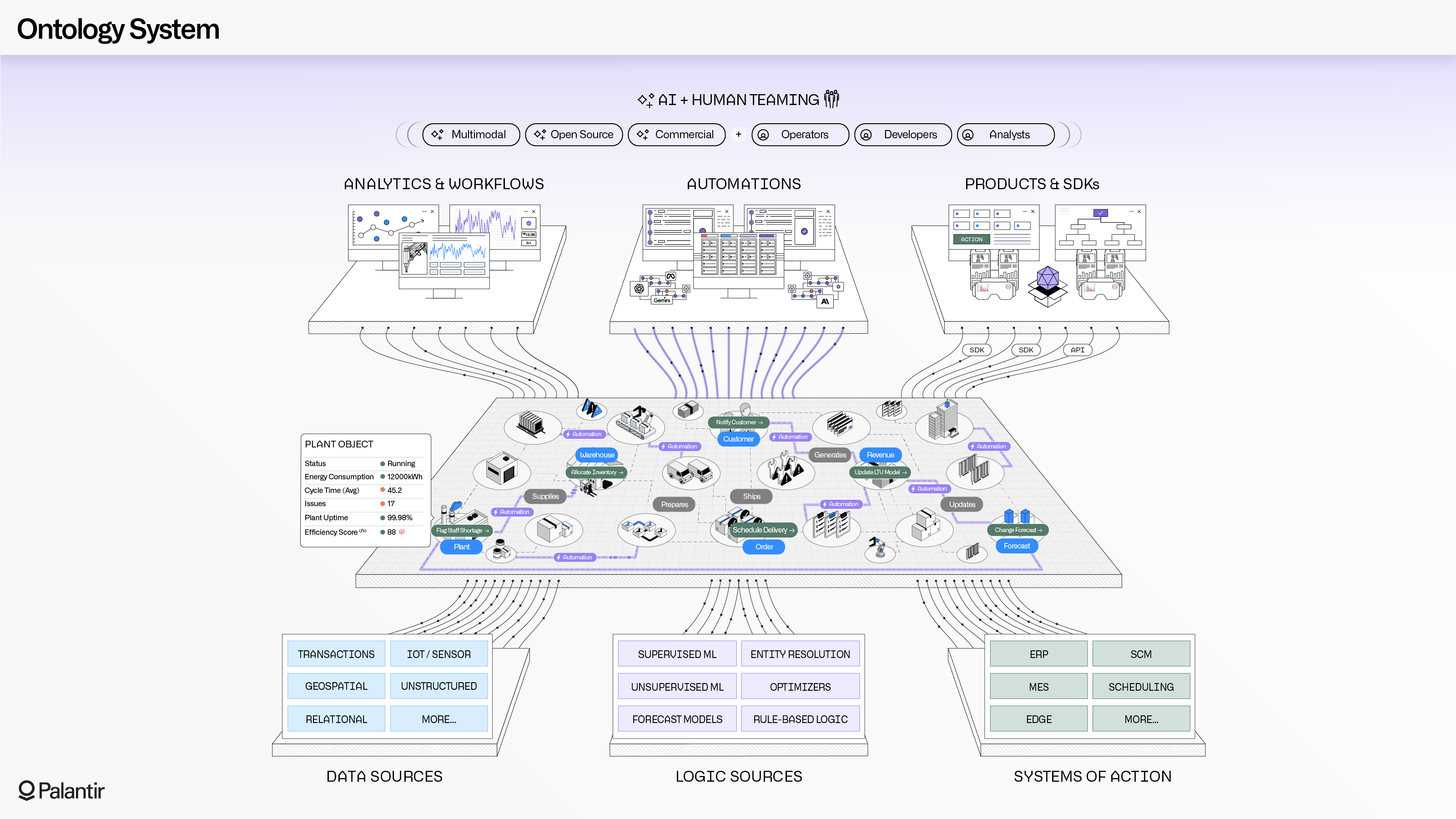
The Ontology sits between data, logic, and systems of action below, and the applications, automations, and teams acting on the enterprise above.
objects & relationships (nouns)"] L["Logic
functions & rules (how to compute)"] A["Action
executable operations (verbs)"] end base[("Datasets / virtual tables / ML models")] --> OL S["Security · runs through everything
who can see what · who can do what"] -. covers all .-> OL
Three-layer architecture = three progressively deeper questions
The essence of Palantir Ontology is that it uses three layers to answer three distinct questions:
| Layer | Question it answers | Pain point it solves |
|---|---|---|
| Semantic | What is the world (What is) | Data you can’t understand |
| Kinetic | What we can do (What we do) | Data you can’t use or change |
| Dynamic | How the world evolves (How it evolves) | Having to rebuild from scratch once scale grows |
objects · properties · links → unified business dictionary / SSOT
cures: data you can't understand"] K["Kinetic layer — What we can do
Action Type · Function → ACID / bidirectional write-back / permission audit
cures: data you can't use or change"] Dy["Dynamic layer — How the world evolves
ontology iteration · action optimization · rule evolution · backward compatibility
cures: having to rebuild from scratch at scale"] S --> K --> Dy
Semantic layer: a “living” business dictionary
The semantic layer defines the enterprise’s core entities, properties, and relationships — essentially a unified, unambiguous “business dictionary.” The three names mentioned earlier — KNA1 / Account / dim_customer — are here mapped uniformly onto one standard object, Customer, unifying KNA1.KUNNR / Account.Id into Customer.id and providing a Single Source of Truth (SSOT).
But the single most important word in the semantic layer is “living.” It’s not a static schema definition but a “living graph model” bound directly to the underlying real-time data flows:
| Dimension | Semantic layer (graph model) | Traditional database schema |
|---|---|---|
| Data sync | Real-time dynamic projection; underlying changes reflected instantly | Static definition, dependent on batch ETL sync |
| Flexibility | Easy to modify and extend, decoupled from underlying storage | Extremely costly to modify, may cause service outages |
| Data form | A unified linked graph model | Scattered table structures, relationships implicit |
Precisely because the model is “living,” business users can query it directly in natural language: “Show me the average vibration reading for all production equipment whose status is ‘awaiting repair’ and that is located at the ‘Shanghai plant’ over the past 24 hours.” The system automatically parses out the objects, filter conditions, and aggregation logic — self-service exploration without knowing SQL.
Kinetic layer: turning a “read-only model” into an “executable model”
This is where Palantir truly parts ways with the first two kinds of ontology. Traditional data models are “read-only”: you can query and analyze, but you can’t execute business operations directly on the model. The kinetic layer gives data the capacity to act.
Its core is the Action Type — a business operation bound to a specific object, such as CreateMaintenanceTicket on an Equipment object or ApproveTransaction on a Transaction object. These actions have several non-negotiable engineering properties:
- ACID transaction guarantees: action execution obeys atomicity, consistency, isolation, and durability. All steps either all succeed or all roll back, leaving no intermediate state.
- Bidirectional mapping: the semantic layer is responsible for reading data from external systems to build objects; the kinetic layer further defines how to write results back to the source systems. After
ApproveTransactionexecutes, it not only updates the internal state to “approved” but also automatically calls the bank’s API to sync that status back to the core banking system — closing the full loop of “data insight → business operation → landing in the source system.” - Permissions, audit, lineage: every action is bound to fine-grained permissions (RBAC roles + ABAC attributes);
ApproveTransactionmight be visible only to the “finance manager” role. Every operation is written to an immutable audit log (who, when, what parameters, success or failure).
An action can be triggered in four ways: a property change (equipment temperature exceeds 80°C), a function result (risk score exceeds 90), a schedule (2 a.m. daily), or manually (a support agent clicks “create ticket”). This is the watershed: with the kinetic layer, the manual gap between “analyzing which equipment needs servicing” and “dispatching a work order with a single click” disappears.
Dynamic layer: letting the system “grow itself” instead of “rebuilding from scratch”
Traditional enterprise systems carry a well-known curse: when data volume grows from GB to PB and concurrency from 10 users to 100,000, the architecture can’t hold and the only option left is to tear it down and rebuild. The dynamic layer is the adaptive evolution layer built to break this curse, and it manages four things: ontology iteration (automatically suggesting, based on feedback, that a high-frequency long-tail field be promoted to a standard property), action optimization (noticing that 90% of approvals are passed by the same role and suggesting an “auto-approve”), rule evolution (mining new patterns from historical data to generate alerting rules), and compatibility guarantees (any change is strictly backward-compatible; versioning lets old and new coexist, enabling seamless upgrades).
It plays a dual role: it’s both an immune system (defending against environmental change) and an evolution engine (driving the ontology’s continuous evolution).
The five atomic elements: the microscopic building blocks
The three-layer architecture is the macroscopic skeleton; microscopically, the whole ontology is assembled from five atomic elements:
- Object: the “nouns” of the business world, such as
CustomerandEquipment. - Property: an object’s “characteristics,” such as
nameandtemperature. - Link: the “relationships” between objects, such as “an order is placed by a customer.”
- Function: an object’s “computational ability,” such as computing a customer’s lifetime value (LTV).
- Action: an object’s “capacity to act,” such as freezing an account or creating a work order.
Here’s a misconception engineers should be most on guard against: an Object is not a MySQL business table. If you think it’s just a table, you’ll completely misjudge the boundaries of its capabilities. Logically you use it as a “business entity”; physically it’s a composite of “a metadata table + a graph node + a columnar wide table + a sparse KV store + a time-series table” — fixed fields go into the columnar wide table, dynamic sparse fields go into a [UID + Key + Value] key-value store, and real-time high-frequency fields (like temperature) go into a time-series partitioned table. By the same token, a Link is an “Edge” in a graph database, not a foreign key, supporting multi-hop queries that trace layer by layer along a chain of relationships — like “find someone’s father’s ex-wife’s ex-husband.” Doing this with foreign-key JOINs would grind to a halt; with graph edges it’s a native operation.
One logical object, physically a composite of five kinds of storage:
e.g., Equipment A-017"] LOGIC -.-> META["Metadata table
type definition · RID"] LOGIC -.-> GRAPH["Graph node
carries Link edges"] LOGIC -.-> WIDE["Columnar wide table
fixed fields"] LOGIC -.-> KV["Sparse KV
UID+Key+Value · dynamic sparse fields"] LOGIC -.-> TS["Time-series partitioned table
real-time high-frequency fields (e.g., temperature)"]
Beyond these five elements, Palantir layers on several advanced abstractions that uphold the engineering rigor of the “living model”:
- Interface: the ontology’s polymorphism mechanism. It defines a set of shared properties and capabilities (such as
Inspectable,Schedulable) for different object types to implement. A workflow built on theSchedulableResourceinterface can adapt to meeting rooms, vehicles, and arenas without modification. - Shared Property: a property definition reused across multiple object types, avoiding the need to define the same “email” field ten times across ten objects.
- Value Type: a semantic type wrapper that gives a bare type like “string” a business meaning and dynamic constraints (for example, “this is a phone number conforming to the E.164 format”).
- RID (Resource Identifier): the globally stable primary key of an ontology object, the anchor for all links, actions, and audits.
- Object Set: a reference to a group of objects, either static (a list of primary keys) or dynamic (a filter that updates automatically as data changes) — the input/output unit of nearly all ontology operations.
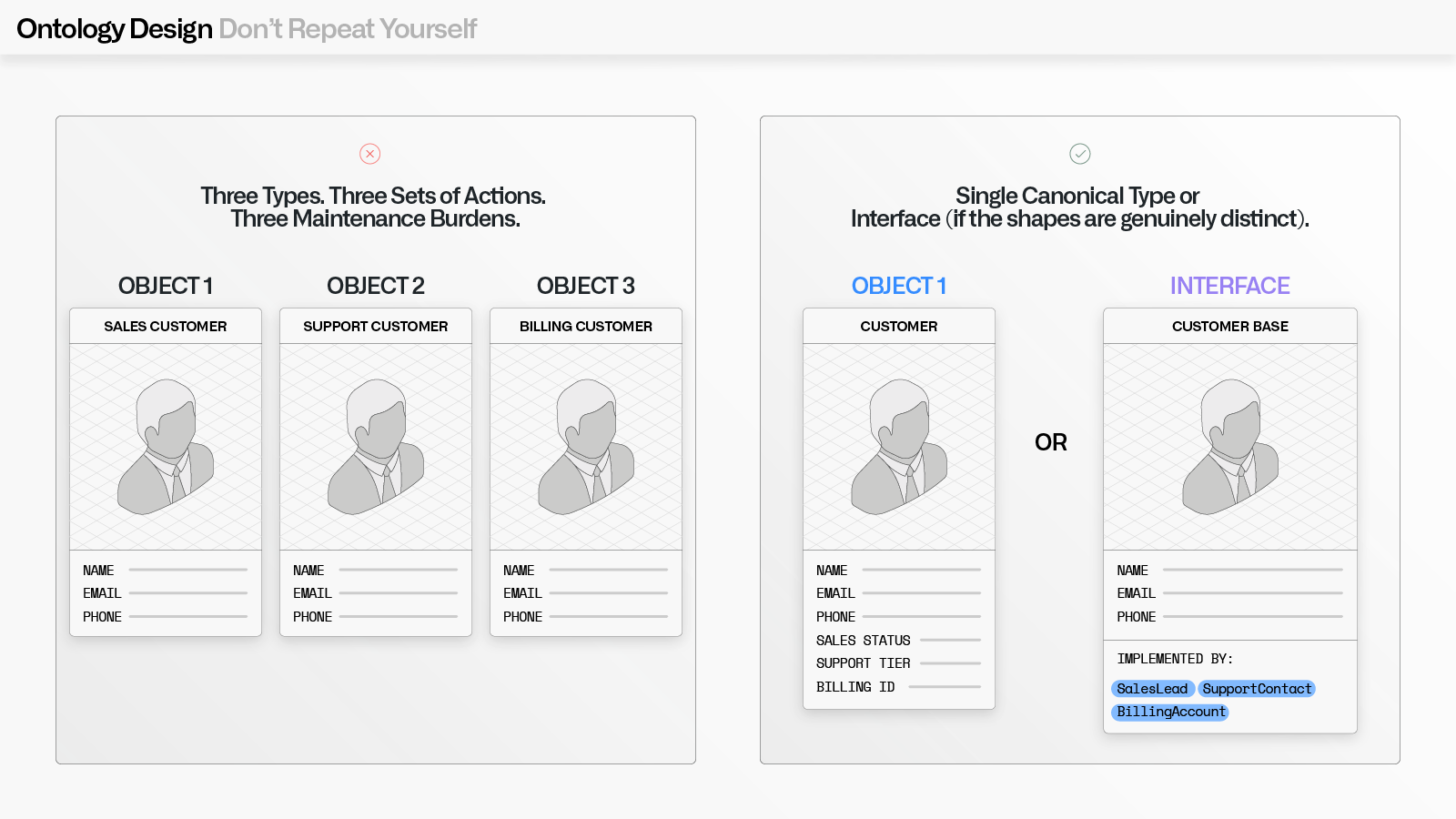
Why Interfaces and shared properties are needed: three separate, siloed “Customer” objects mean three sets of actions and three maintenance burdens; converge them into a single canonical type, or — when the forms genuinely differ — have each type implement the same interface.
We must here distinguish a pair of concepts that runs throughout: Object Type vs. Object Instance. The former is a schema-level definition (“what equipment is”); the latter is the individual real records at the data layer (“that piece of equipment numbered A-017 in Workshop 3”). Likewise, Ontology Types and Data Types are two different things — the former are concepts at the business-semantic layer, the latter are physical types in the underlying storage. Conflating these two layers is the most common modeling accident for beginners.
The official view: Language / Engine / Toolchain
If you find “three-layer architecture” too much of an external framing, Palantir’s official document The Ontology System gives an internal three-way decomposition [Official]: Language (the type system and semantics that describe the ontology), Engine (the backend engine for storage, indexing, and execution), and Toolchain (the tool suite for modeling, applications, and governance). We’ll put this division to good use when we discuss the backend architecture in Section 4.
So the conclusion of Section 3: Palantir Ontology is an operational decision layer that welds “data, logic, action, and security” into one. The three-layer architecture makes it “come alive, move, and grow”; the five elements plus interfaces / value types / RID are its atomic building blocks. It’s not a knowledge graph plus scripts — it’s the entire data operating system reorganized from scratch.
4. How (Part 1): Its Relationship to Other Systems, and the Truth About the Backend
Now that the abstractions are covered, let’s descend to the systems level. Palantir Ontology never exists in isolation — it lives inside a whole “enterprise operating system.”
The enterprise-OS trio: Foundry + AIP + Apollo
Palantir was founded in 2003, its name taken from the “palantír” — the seeing-stones in The Lord of the Rings used to communicate and observe the world. It likens its own tech stack to an enterprise operating system:
- Foundry: the OS kernel, responsible for data — connecting, transforming, modeling, governing. This is where the Ontology lives.
- AIP (Artificial Intelligence Platform): the AI runtime, letting LLMs and agents safely perceive, reason, and act on top of the ontology.
- Apollo: the update and deployment mechanism, responsible for safely delivering software to every corner, from the public cloud to a military air-gapped environment.
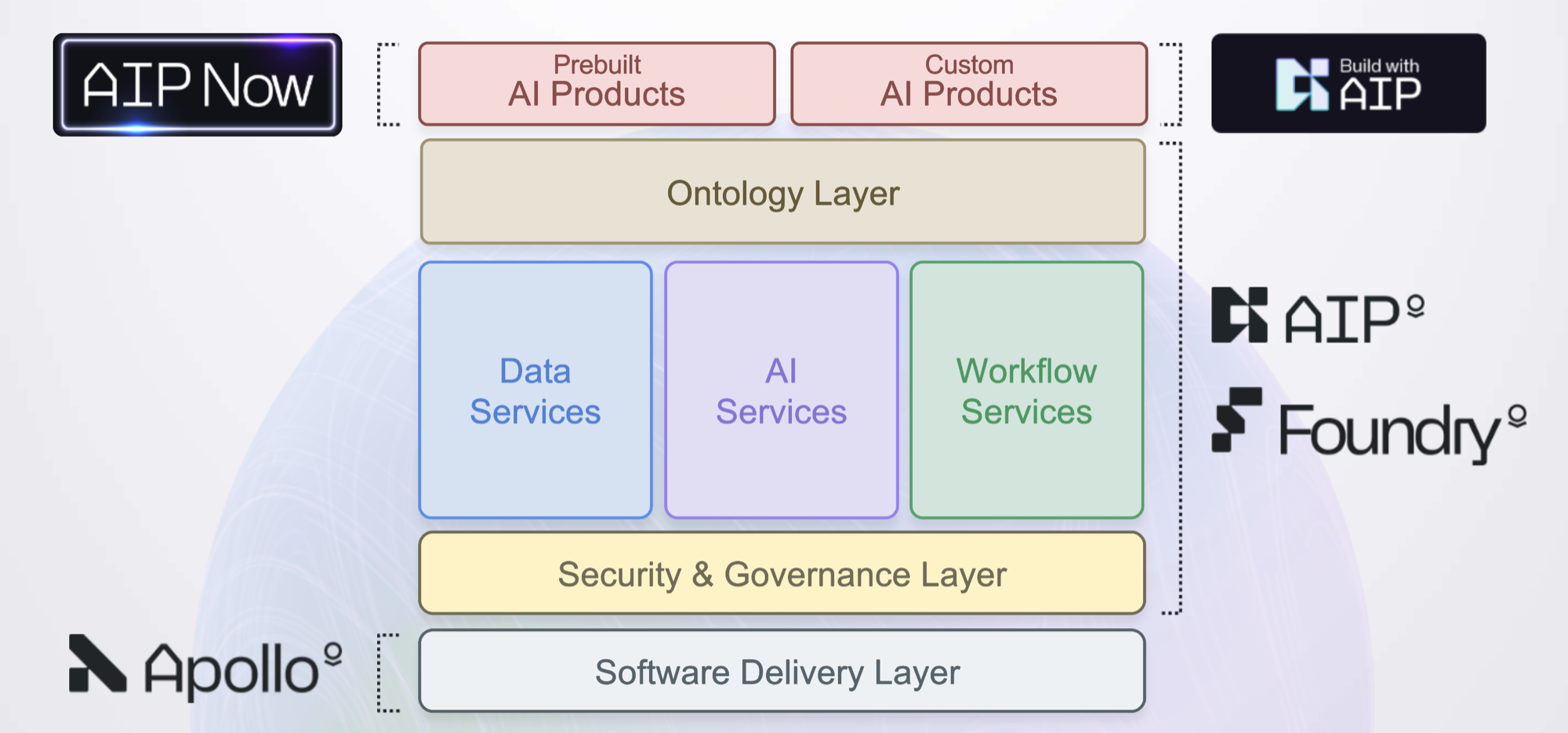
The trio’s division of labor is clear at a glance in the official architecture diagram: the Ontology Layer sits exactly between the AI products and Foundry’s data services, with Apollo underpinning the entire software-delivery layer.
This system is no small thing: AIP + Foundry officially claims to be built from 300+ microservices, adopting a zero-trust architecture and defending against advanced persistent threats by actively rotating nodes; Apollo orchestrates tens of thousands of releases per week [Official]. Underneath, it runs on a zero-trust Kubernetes substrate called Rubix, where nodes rotate every 48 hours to make it hard for an attacker to persist [Official].
Foundry vs. Gotham: two children of the same origin, different forms
Many people can’t tell Foundry and Gotham apart. The truth: they share the same ontology kernel and tech stack; the differences are mainly in mission profile, data-ingestion parsers, and security paradigm — not in the engineering stack.
- Gotham (named after Batman’s Gotham City): Palantir’s first product, from 2003, serving government and defense intelligence. Its core is the O-R-E model (Objects / Raw data / Events), its tools are Graph, Map, Object Explorer, and Dossier, and it runs on classified networks and the tactical edge.
- Foundry (meaning a metal-casting works): later commercialized Gotham’s capabilities to serve commercial enterprises. Its core is the Object / Link / Action / Function model, and its tools are Contour, Workshop, and Vertex.
Worth noting is Palantir Defense Ontology — the defense version of the ontology, which captures, for each object and relationship, additional provenance (source system), spatiotemporal context, and a confidence score on a 1–5 scale. This is also why it can underpin military programs like TITAN (we’ll return to this in the controversy section).
The six backend components and the storage evolution
The Ontology’s backend is a set of collaborating microservices, with six components each playing its part:
- OMS (Ontology Metadata Service): the top-level definition, the source of truth for the global schema. The metadata for object/link/action types is registered, versioned, and validated here.
- Object database: stores indexed objects, optimized for fast point lookups and state management.
- OSS (Object Set Service): the read layer, the primary query gateway, responsible for search, filtering, and aggregation.
- Actions service: the transaction-processing engine, executing permission-constrained structured edits.
- Object Data Funnel (“Funnel”): an indexing backbone new in OSv2, unifying the two write paths of “data source” and “Actions edits” and keeping the physical source consistent with the logical ontology.
- Functions on Objects: executes code within an operational context.
SAP · Oracle · warehouse")] --> FUNNEL subgraph WRITE["Write path (two channels feeding the indexing backbone)"] FUNNEL["Object Data Funnel
OSv2 indexing backbone"] ACT["Actions service
transaction engine · ACID"] --> FUNNEL end OMS["OMS · source of truth for global schema
object/link/action types registered · versioned · validated"] -. constrains .-> FUNNEL FUNNEL --> ODB[("Object database
fast point lookups · state management")] ODB --> OSS["OSS · read layer / primary query gateway
search · filter · aggregate"] OSS --> USER["Humans / AI agents"] USER -- structured edits --> ACT FOO["Functions on Objects
code execution in operational context"] -. compute .-> OSS
This backend went through a key generational evolution — OSv1 (codename Phonograph) → OSv2:
| Dimension | OSv1 (Phonograph) | OSv2 |
|---|---|---|
| Architecture | Monolith with coupled indexing/query/edit | Indexing and query subsystems decoupled, horizontally scalable |
| Retrieval ceiling | Hard cap of 10,000 records | Up to tens of billions of objects indexable per type [Official/Unverified] |
| Indexing | Mostly full re-index | Incremental indexing on by default |
| Security | Dataset-level | MDO column-level / row-level fine-grained permissions |
| Status | Deprecated on 2026-06-30 | Next-generation canonical storage |
OSv1 is slated for deprecation on June 30, 2026, requiring migration via the Upgrade Assistant [Official]. The most notable thing in OSv2 is the MDO (Multi-Datasource Object): a single object type can be backed by multiple heterogeneous data sources — for example, an Employee’s contact info coming from a public directory while payroll comes from a controlled HR system, isolated by column-level permissions; or full instances of the same schema coming from multiple departments, isolated by row-level permissions. This is zero-trust landed at the ontology layer.
(Reminder: several orders of magnitude in this section — “tens of billions of objects,” “a single Action editing tens of thousands of objects” — are marketing-grade figures from official documentation, lacking independent benchmarks, tagged [Unverified].)
The key judgment: it’s a “materialized index layer,” not a “federated query layer”
This is the hardest point in understanding Palantir’s architectural trade-offs. The competitor PuppyGraph puts it incisively: Palantir Ontology is a “highly materialized and indexed layer, not a pure federated query layer” [Competitor, but technically accurate].
What does that mean? Data must first flow in through Foundry pipelines and be pre-indexed by the Funnel into the object database before it can be used in object form; it does not query external OLTP databases or lakehouses directly. Contrast this with semantic layers (dbt / Snowflake Semantic Views): those generate SQL at query time to access the underlying tables and are read-only; whereas the Ontology is pre-indexed, its read path independent of the source systems, and writable (writing directly to the backend via Action Types).
This trade-off is double-edged. Materialization buys you: runtime governance, controlled write paths, decision capture, and sub-second object retrieval. But the cost is: data integration becomes a precondition rather than an option, there’s a freshness lag, there’s an extra copy of storage to pay for, and — as we’ll emphasize later — it intensifies platform lock-in.
AIP: how the ontology tames the LLM
AIP’s role is to use the ontology to build a “semantic cage” for the LLM, upgrading it from “chatting” to “acting.” The core technical innovation here is how OAG (Ontology-Augmented Generation) surpasses standard RAG.
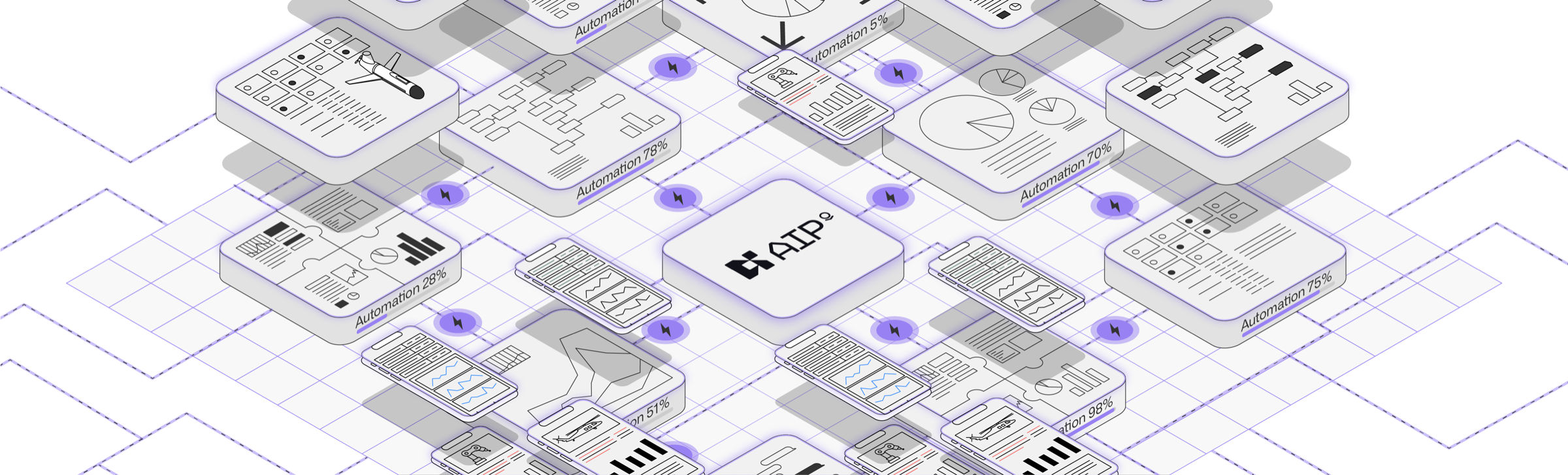
The official visual hides AIP’s core thesis: autonomy is a dial, not a switch — each workflow’s automation level (5%→98%) is dialed up independently and gradually, rather than jumping to full automation in one step.
Ordinary RAG fishes similar text chunks out of a vector store to feed the LLM; OAG instead forces the LLM to retrieve structured, typed objects through the OSS — carrying deterministic properties and explicit relationship edges. This is a neuro-symbolic paradigm. The gap between the two is systematic:
| Dimension | Standard RAG | Ontology-Augmented Generation (OAG) |
|---|---|---|
| Retrieved content | Similar text chunks | Structured, typed objects |
| Hallucination tendency | High | Low (schema-constrained) |
| Schema enforcement | None | Strict (won’t retrieve deprecated fields) |
| Real-time access | Index has lag | Direct read via OSS |
| Provenance | Fuzzy | Complete provenance chain |
| Mathematical computation | Relies on the LLM (error-prone) | Delegated to deterministic tools |
| Governance granularity | Document-level | Object/property-level |
| Ability to act | Text output only | Can trigger ontology actions |
The last two rows are the killer feature. In OAG, when precise computation is needed, the LLM doesn’t try to do the math itself — it recognizes intent and then calls an ontology function, which in turn calls an external solver (like NVIDIA cuOpt for operations-research optimization or Prophet for time-series forecasting), returning only the validated, deterministic result for the LLM to synthesize into final language. This demotes the LLM from a “source of knowledge” to a “coordinator” — evolving from “retrieval augmentation” to “capability augmentation.” The accompanying k-LLM architecture makes the underlying model hot-swappable (freely switch between xAI / OpenAI / Anthropic / Google), because in this philosophy, the LLM is a replaceable component and the ontology is the authoritative world model.
demoted to coordinator"] LLM -- recognize intent --> OSS["OSS structured retrieval
typed objects · properties · relationship edges"] OSS --> KG[("Governed ontology graph
schema-constrained · full provenance")] LLM -- needs precise computation --> FN["Ontology function"] FN --> SOLVER["External deterministic solver
cuOpt for OR · Prophet for time series"] SOLVER -- returns only validated results --> LLM KG -- structured facts --> LLM LLM -- language synthesis --> OUT["Answer"] LLM -- triggers --> ACTION["Ontology Action (can change the world)"]
How does this capability climb step by step? Tampa General Hospital’s case offers a three-tier progressive sample [Official case]: L1 data coordination (using an operational digital twin to manage “patient-room-bed” relationships) → L2 language interface (OAG turning natural language into structured retrieval) → L3 autonomous Agent (monitoring patient conditions, drafting plans, coordinating resources, requiring only final human approval).
Apollo and the edge: delivering the ontology to places with no network
Apollo adopts a declarative pull model: the center only declares “what artifacts I want to release and what constraints they depend on,” then the artifacts flow through the RELEASE → CANARY → STABLE channels, and each environment’s autonomous agent decides for itself “whether the current maintenance window, schema version, and compliance constraints are satisfied” — pulling and deploying only once they are. This is a shift from “central push” to “edge autonomy,” and it’s key to covering air-gapped environments: in Airgapped SaaS mode, an encrypted, signed, self-contained artifact bundle can even cross the air gap on physical media, to be verified and autonomously deployed by an agent inside the gap.
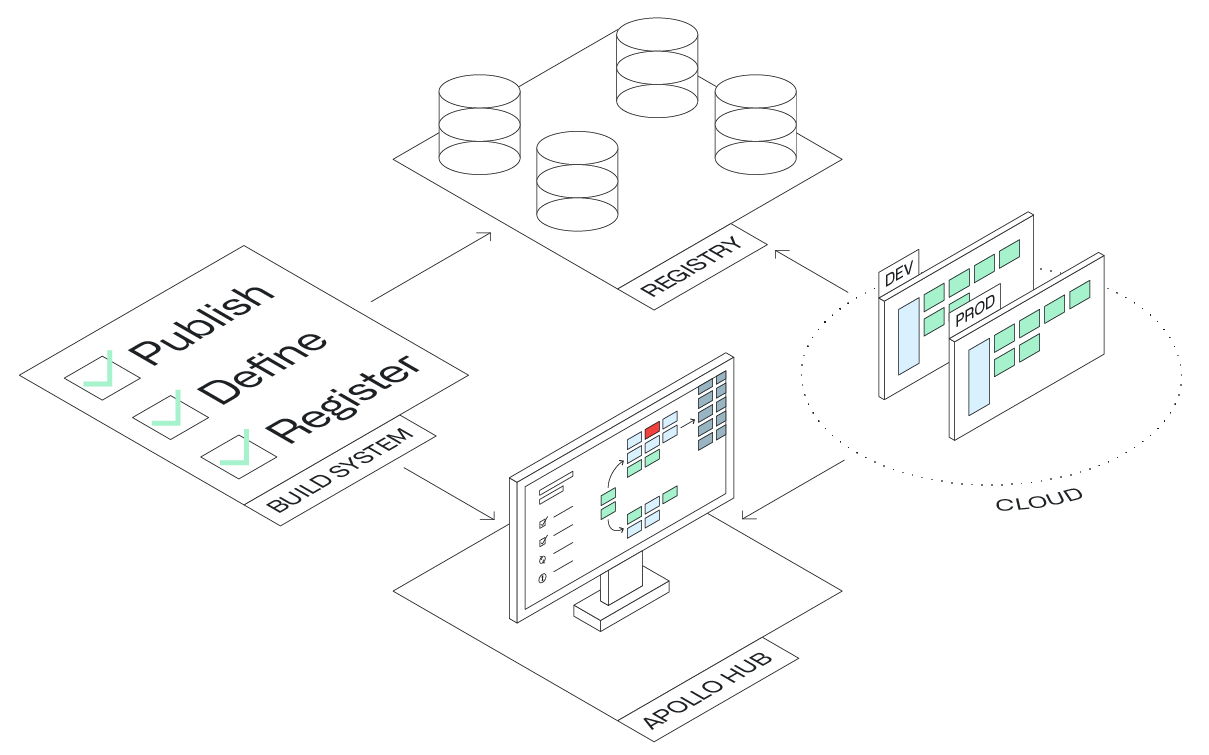
The closed loop of declarative pull: the build system is only responsible for publishing and registering; each environment’s agent decides and pulls on its own, per the constraints declared by Apollo Hub.
Going further to the edge, there’s Embedded Ontology: a lightweight, edge-native ontology instance that can autonomously perform full CRUD offline with latency under 10 milliseconds; when connected, it syncs with the global ontology, buffering during disconnection and resolving conflicts on reconnect. Underneath it runs on single-node OpenShift, interfacing with industrial equipment via OPC UA / MQTT. In a phrase: one ontology model, two environments, unified context.
So the conclusion of Section 4: the Ontology isn’t a standalone product but the nerve center of the Foundry/AIP/Apollo enterprise operating system. It trades “materialized indexing” for runtime governance and write capability, uses OAG to cage the LLM in determinism, and uses Apollo to deliver itself everywhere from the cloud to the tactical edge.
5. How (Part 2): How an Ontology Actually Gets Built
Having understood the architecture, one last engineering question remains: to actually land this, how do you build it from zero to one?
A five-step process + zero-code modeling
Palantir operationalizes modeling into five ordered steps, all done in the Ontology Builder via visual drag-and-drop plus form configuration, in exactly the order Object → Property → Link → Function → Action:
books.csv → Book
auto-suggests primary key book_id"] --> P["② Add Property
title · price · stock status"] P --> L["③ Establish Link
written_by
cardinality 1:N"] L --> F["④ Write Function
price × 0.8 → discount price
virtual property · not persisted"] F --> A["⑤ Create Action
Mark_As_Sold
update stock + send email + call API"]
- Define Object: map a “Book” entity from
books.csv; the system auto-suggestsbook_idas the primary key; - Add Property: drag in fields (title, price), or add manually (stock status, an enum: In Stock / On Loan / Sold);
- Establish Link: relate “Book” and “Author” via
author_idintowritten_by, defining the cardinality (one author writes many books, 1:N); - Write Function:
price * 0.8computes the virtual property “discount price” (not persisted, existing as a virtual property); - Create Action: define
Mark_As_Sold— when stock status changes to “Sold,” update the database, send a notification email, and call/api/inventory/reduceto decrement stock.
Business users “draw” entities and “connect” relationships on the interface, and the platform automatically generates the metadata, creates the graph’s nodes and edges, allocates storage, and schedules computation underneath. The people who understand the business are no longer bystanders — they can drive the modeling directly.
That said, let’s throw some cold water on “zero-code.” The Function in step 4, when as simple as price*0.8, is indeed zero-code; but a finance multi-factor risk score Calculate_Risk() or an ML failure-probability prediction Predict_Failure_Probability() for power grids may no longer be pure drag-and-drop — complex logic and external model calls still often require writing code. “Zero-code” is a marketing-friendly phrasing; building a production-grade ontology is often measured in months.
Use-case delivery: work backward from the “outcome,” not forward from the “method”
Palantir has an explicit delivery methodology whose core organizing unit is the Use Case — the effort by a dedicated team, within a bounded time, to support a specific decision. It has three methodological tenets:
- Outcome-oriented framing: define the project from the desired decision, not from the tool. The anti-example is “we need a sales dashboard”; the correct example is “we need to make decisions about time and resource allocation across sales regions.” The former locks in the implementation; the latter leaves room to maneuver.
- Problem decomposition: break the use case into small steps, each mapped to a specific tool.
- Tool-maturity path: swap tools for the same need as maturity grows — Contour (rapid prototype exploration) → Dashboard (gather feedback) → Code Repositories (productionize, schedulable) → Workshop / Slate (custom applications, decision write-back).
Behind this is the “data-driven loop” — use data to make decisions → capture decisions → evaluate impact — which adds the two links of “decision capture + impact evaluation” over pure technical automation, emphasizing organizational learning.
The four design principles: prioritized trade-offs
Palantir’s official best practices give four design principles; note that they have an explicit priority order and, in conflict, the higher priority wins [Official]:
- Domain-Driven Design (highest priority): model the real world, not a mirror of the source systems’ table structures. Object types should represent semantic concepts like “patient” and “work order,” not database tables; name things in business language (
lastInspectionDate), not source field names (dtLastInspMod). The biggest anti-pattern is called the “kitchen sink” — dragging source tables in 1:1 as objects. - DRY (the Rule of Three): build the same thing a third time and it’s time to refactor — “once is a coincidence, twice is a pattern, three times you refactor.” Extract shared logic into interfaces or shared functions.
- Open-Closed Principle: once the core model goes live it stays stable; others extend it by “adding new objects, adding interface implementations” rather than modifying the core, to avoid cascading breakage of downstream applications.
- Composition over (deep) inheritance: compose capabilities via multiple inheritance of interfaces (
Inspectable+Schedulable), rather than building a rigid, deep inheritance chain.
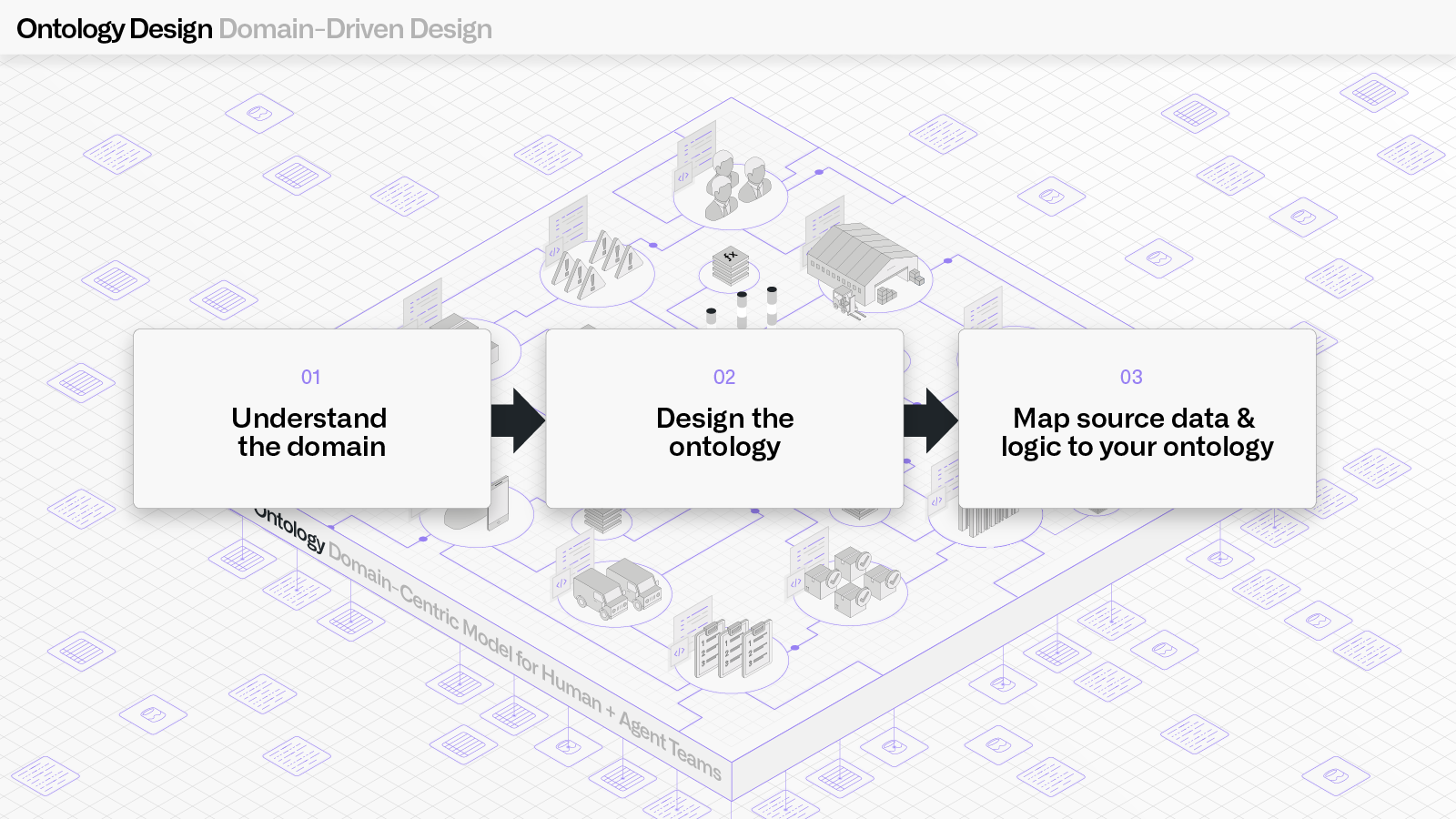
The official illustration of the highest-priority principle: understand the domain first, then design the ontology, and only then map the source data on top — reverse the order and you get the “kitchen sink” anti-pattern.
Above all this sits one more principle, pragmatism: deadlines, legacy systems, and team skills are all real constraints, and consciously and temporarily deviating from the ideal design is allowed — but mark the technical debt explicitly and plan the migration. The core creed is this — the ontology is software that drives the organization; treat it with the same care you give production code.
There’s a real engineering trade-off worth mentioning here: normalization vs. performance. Normalized modeling (multiple objects + Links) is semantically clear, but traversing multiple objects in Workshop degrades performance, and derived properties can only operate on directly linked objects — you can’t directly compute a derived property across an “indirect link” (like Budget → Customer → Orders). This is a pain point discussed repeatedly in the community; the usual fix is to use a Function to do an “internal hop” aggregation, or to denormalize moderately. Prioritize business semantics; don’t optimize prematurely.
The data side: weaving, not hauling
The semantic layer claims to “project the underlying data in real time,” and it does so through the philosophy of a Data Fabric rather than physical migration: semantic annotation (labeling both the CRM’s cust_id and the ERP’s client_number as Customer.id) → defining mapping rules (which live in a logical layer) → resolving in real time at query time, assembling a unified view in memory. Changing the mappings in the logical layer is far easier than redoing the physical data integration.
| Dimension | Data Fabric | Traditional ETL |
|---|---|---|
| Integration method | Logical integration, built at query time | Physical migration, copied to unified storage |
| Real-time-ness | High, on-demand access | Low, dependent on batch processing |
| Storage cost | Low, no redundancy | High, must maintain copies |
| Flexibility | High, just change the mapping | Low, must redesign the pipeline |
Whether the “single source of truth” can actually be realized hinges entirely on Entity Resolution — merging the multiple records that describe the same entity across systems into a “golden record.” Three techniques work together: deterministic matching (relying on unique IDs like national ID or employee number; 100% accurate but can’t cover the long tail), probabilistic matching (when there’s no unique ID, using TF-IDF, cosine similarity, and random forests to compute a similarity-confidence score over name, address, and phone), and survivorship rules (arbitration logic for conflicting information, such as “trust the most recently updated system”).
HyperAuto / SAP: cracking the hard nut of the ERP
An enterprise’s largest data source is often SAP. Palantir uses HyperAuto to automatically map the table structures of SAP and Oracle into typed ontology objects within minutes (traditional manual modeling takes months) — it can automatically infer foreign-key relationships, field semantics, and entity boundaries. The technical foundation is a certified connector (ABAP plugin) installed in the SAP NetWeaver application layer, communicating over HTTPS without directly accessing the database; it uses the SLT Replication Server for Change Data Capture (CDC) (syncing only increments, avoiding the impact of a full load on the production system); and write-back goes through SAP’s BAPI remote functions, with user-driven write-back using the OAuth 2.0 authorization-code flow to ensure operations are correctly attributed to specific users (crucial for auditing).
This draws out a beautiful division-of-labor philosophy that the SAP ecosystem itself endorses [SAP]: SAP is the “System of Record,” Palantir is the “System of Action.” SAP handles transactional integrity, master-data governance, and compliance enforcement; Palantir handles cross-system AI decisions and orchestration. The two are complementary rather than competitive — Palantir sits as an orchestration layer on top of existing systems, not requiring you to rip out SAP, thereby protecting SAP’s “Clean Core.” This is the so-called non-destructive orchestration.
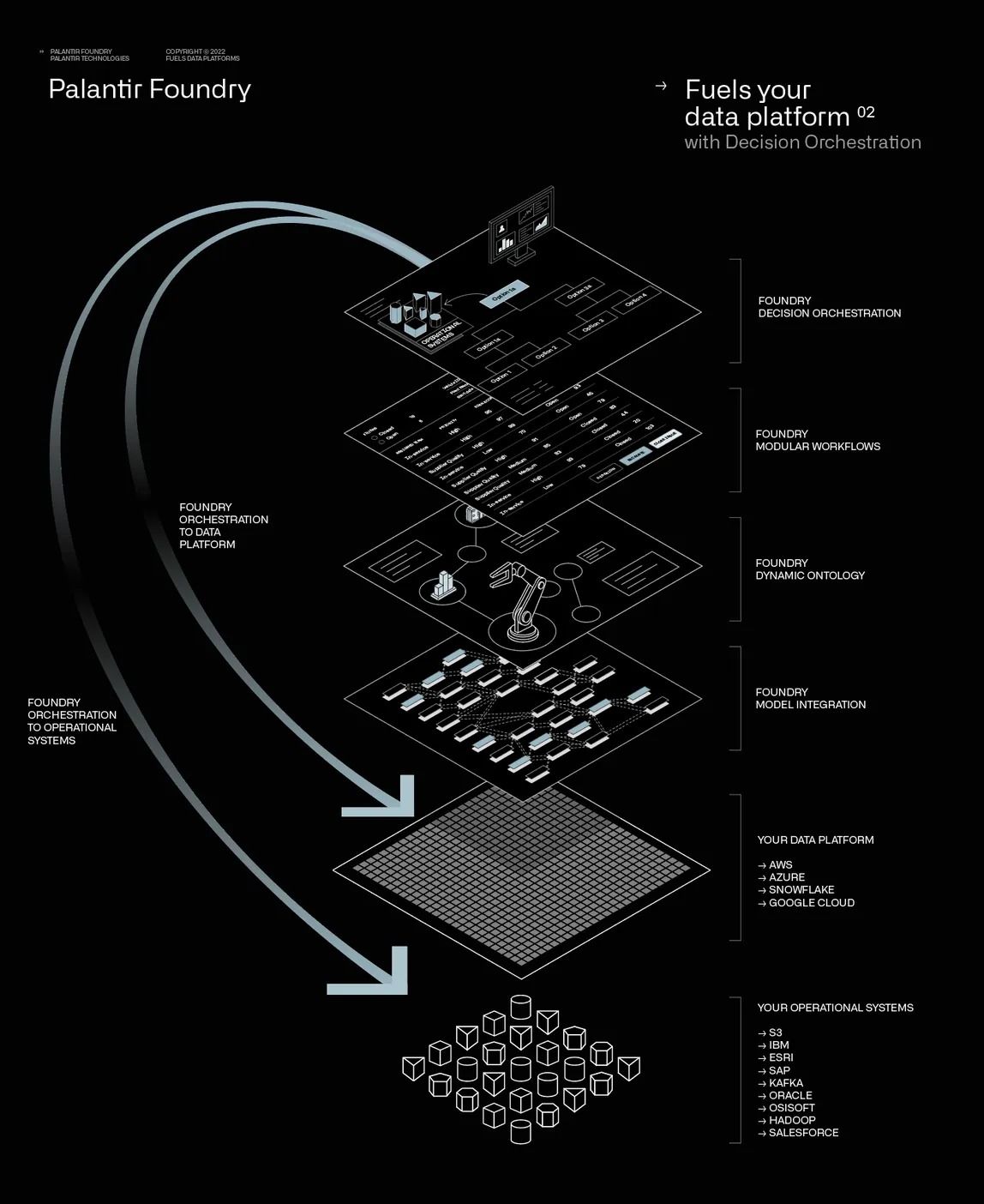
The “orchestration layer” from Foundry’s official viewpoint: the dynamic ontology sits at the center, orchestrating existing data platforms and operational systems like SAP and Oracle below — the system of record stays in place while the system of action layers on top.
The organizational side: FDE and PoV
Finally, two non-technical factors that decide success or failure. FDE (Forward Deployed Engineering) is Palantir’s organizational engine — engineers embedded directly on the customer’s site, understanding the real business and data constraints, continuously feeding frontline feedback back to the core product team like a “gradient signal” (officially likened to “human-scale backpropagation”). This playbook supports Palantir’s coverage of 50+ verticals. And PoV (Proof of Value) is the commercial design that lowers adoption risk — using the implementer’s ready-made Foundry instance to first produce measurable business value on real data, so the customer sees results before deciding whether to commit to a multi-year license (some implementation partners report going from PoV to production in 8–10 weeks) [Independent/Partner].
So the conclusion of Section 5: building a Palantir ontology is, technically, the light narrative of “five steps + zero-code,” but in practice it’s the systems engineering of “outcome-oriented use-case delivery + prioritized design principles + data fabric and entity resolution + cracking the hard ERP nut + FDE on-site deployment.” “Zero-code” gets you started, but what makes an ontology truly drive the organization is the methodological discipline behind all of it.
6. Costs, Controversies, and Cold Reflection
If the previous five sections left you thinking Palantir Ontology is near perfect, this section is here to tilt the scale back. Anything powerful has a corresponding cost, and Palantir’s costs are exceptionally heavy, its controversies exceptionally sharp.
The strengths: why it’s worth the price
Let’s be clear about where it’s strong before we talk cost:
- Integration: it’s the only solution on the market that bundles schema (objects/links/interfaces) + behavior (actions/functions) + governance (role/attribute-level security) into a single system. Other solutions have only a semantic layer, or only graph storage, or only a workflow engine; Palantir gives you all of it at once.
- Moat and switching cost: each customer’s ontology is a unique mapping of its operations, not a generic template. Once the initial “brain surgery” of “connecting and modeling all data sources” is complete, the ontology becomes the organization’s “central nervous system,” and the cost of replacing it is extremely high. UBS analysts flatly state that customers generally don’t believe they could DIY an equivalent replacement from a general-purpose LLM [Independent].
- Decision compounding: every decision made through the ontology is captured and becomes a new data asset, getting “smarter” the more it’s used.
- Enterprise digital twin: what it builds is a “living representation” of the whole enterprise — understanding the relationships among inventory, logistics, legal constraints, and customer commitments — so AI agents are plugged into an environment that “already understands the business context” rather than guessing from scratch.
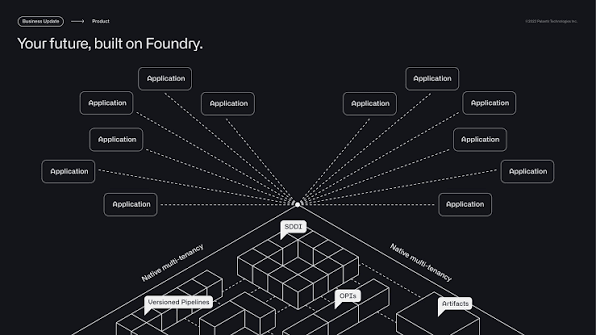
One image explains both the selling point and the worry: all applications grow on the same base — this is the intuitive form of “integration” and “central nervous system,” and precisely the root of the lock-in controversy in the next section.
The weaknesses: lock-in is carved into the bone
Palantir’s biggest point of controversy is vendor lock-in, and this lock-in isn’t optional — it’s an inevitable product of the architecture:
- The ontology can’t run outside Foundry: it’s a proprietary component of Foundry with no independent export or run mechanism. “Keep the ontology, drop Foundry” is impossible.
- Data must be integrated, not referenced: as said earlier, data must flow in through pipelines and be materialized and indexed, which means every schema change in a source system has to be coordinated with the ontology owner.
- No cross-ontology links: this is an officially confirmed hard limit — object types across different Ontology instances cannot be linked.
- Operational coupling: objects/links/actions all map back to Foundry’s datasets and pipelines; if a pipeline fails, the ontology’s reads and writes are blocked; change an upstream primary key and it can cascade into failures across dependent Actions, Workshop applications, and AIP Logic. Migrating an ontology to another platform isn’t just migrating schema definitions — it means rebuilding the entire data pipeline and indexing layer.
Beyond lock-in, there are two real costs. First, build and governance cost — the material candidly admits the ontology is “heavy, slow, expensive”: a narrow pilot takes 2–6 weeks, the first production domain takes 2–4 months, and multi-domain migration takes a quarter to a year [Independent research report]; and governance is a long-term capability, not a one-off project — the ontology evolves with the business, and without governance it suffers “ontology drift.” Second, the engineering shortcomings the community reports repeatedly — large-scale branch management, configuration management, and end-to-end compatibility testing remain real implementation challenges when multiple teams share one core ontology.
Palantir officially pushes back on the lock-in narrative, saying Foundry is “open at every layer from data integration to decision orchestration” and supports exporting via open formats and APIs [Official]. This rebuttal is partly valid, but it doesn’t change a basic fact: the more deeply you use it to govern, the more you depend on it. Deep integration is itself lock-in.
Weighing the evidence: which numbers are credible, which are marketing
This is the one lesson this article most wants you to take away. Palantir’s narrative is full of enticing quantitative claims, but their evidentiary strength varies enormously:
Official/marketing claims that deserve a question mark [Official/Unverified]:
- The Tyson case: a migration “projected at 10–15 people × 3 years” done “by 1 person in 3–4 months” — this is an AIPCon slide, not an independent benchmark.
- Airbus Skywise accelerating A350 delivery by 33%, and Tampa General cutting sepsis mortality by 68% — both are official case numbers with no third-party review.
- “Tens of billions of objects per type” and “integrating 7+ ERPs in days” — marketing-grade orders of magnitude from official documentation.
- SAP + Palantir migration “compressed from months to weeks” — early cases + a partner’s framing, lacking publicly verifiable detail [SAP/Unverified].
Relatively credible independent evidence [Independent]:
- The open-access academic study of the Danish police’s POL-INTEL: based on interviews with engineers and police users, it finds that the ontology simultaneously shapes both the police organization and policing practice, and notes that “the ontology is not politically neutral — it materially encodes concepts, priorities, and even biases.”
- Palantir’s patent record (dynamic ontology, entity resolution with version control and provenance) proves that ontology-driven modeling is a long-standing architectural theme, not a recent marketing invention.
- Multiple IEEE / arXiv papers analyze Gotham as “dynamic ontology software.”
Competitor claims to discount [Competitor]: PuppyGraph, Timbr, and others cast themselves as the “more open, no lock-in” control group; their technical descriptions are often accurate, but they selectively emphasize dimensions favorable to themselves (like “do you have to copy data”) and generalize their own capability into an “ontology layer” — when in reality most of them only cover the semantic elements, with no Action, functions, governance, or app-building, and thus don’t constitute a complete operational layer.
In a phrase: before you read any Palantir number, first ask “who said it.”
The controversies: the deepest, and the most dangerous, moat
Beyond the technology, Palantir Ontology touches on more sensitive terrain.
The AI-sovereignty critique. Pangeanic’s Manuel Herranz wrote an article whose title sets the tone — Why Palantir’s Ontology Is Its Deepest and Most Dangerous Moat [Independent, critical]. The core thesis: if an organization’s semantic layer is controlled by an external proprietary vendor, then its “AI sovereignty” is weakened. True sovereignty requires control over five things — data, infrastructure, models, governance, and the semantic architecture (the ontology) that connects the first four. He calls Palantir’s business model “captive token consumption”: once workflows, data mappings, security rules, and decision processes are all modeled into the platform, replacement becomes extremely hard. As supporting evidence, he notes that both Switzerland and Denmark have repeatedly declined to adopt Palantir technology.
The dual-use military controversy. The same ontology architecture is both a commercial enterprise’s digital twin and a defense-intelligence engine. In 2024, Palantir won a $178.4 million contract for the U.S. Army’s TITAN program, delivering 10 AI-enabled intelligence ground stations, which the Army calls its “first AI-Defined Vehicle” [Independent, DefenseScoop reporting]. The commercial “System of Record / System of Action” framework bears a structural resemblance to the military’s “Sensor-to-Shooter” chain and the JADC2 multi-domain-operations concept. A technology that can accelerate a supply chain can equally accelerate a kill chain — this isn’t a technical flaw but an ethical tension inherent to this kind of “operational ontology.”
Encoding organizational bias. The Danish-police study mentioned earlier lays bare a subtler problem: when the ontology decides “what a suspect is” and “which relationships are worth attention,” it’s no longer a neutral technical tool but a system that has hardened a particular worldview into itself. The more efficient and invisible this hardening, the more it warrants vigilance.
So the conclusion of Section 6: Palantir Ontology’s power and its danger are two sides of the same coin. The very features that make it a moat — deep integration, decision capture, integrated governance — also make it the hardest dependency to escape, the sharpest dual-use tool, and the least perceptible vehicle for a worldview. Before you use it, these costs must be seen clearly, eyes wide open.
Conclusion: A War Worth Fighting, but One to Fight With Clear Eyes
Having gone all the way around, we return to the question we opened with: why does no one dare let an LLM independently approve a million-dollar transfer? Now, with the ontology as equipment, the answer can be rewritten.
The key is that the ontology and the LLM aren’t substitutes but a division of labor: the ontology provides determinism and constraint (structured knowledge, business rules, traceable justifications, drawing the boundaries of behavior), while the LLM provides flexibility and generation (natural-language understanding, task planning within the framework, handling the long tail). One governs “don’t cross the line,” the other governs “get things done, cleverly.”
The Knora case in the material plays this mechanism to the hilt. The scenario is “a change to a work order’s output quantity must go through approval,” and the logic is identical to the transfer: a user says “change the work order’s output from 500 to 800” → the engine queries the ontology, computes that the change magnitude of 60% exceeds the 20% threshold, hits the rule requiresApproval = true → validation finds the approvedBy relationship missing → intercepts before persisting, generates a structured error report (pinpointing exactly which rule was violated), automatically creates an approval task and routes it to the responsible person → after approval, the relationship is supplied, revalidated, and the write executes. Swap “work order output” for “transfer amount” and “20% threshold” for “100,000 risk-control line,” and you get the very mechanism that makes people dare to hand approval to an AI: the AI can propose, but the proposal must pass through the ontology’s rule validation; a non-compliant instruction is intercepted before persisting, and every interception can answer “why.”
change magnitude 60% > 20% threshold
hits requiresApproval = true"] R --> C{"Constraint validation
does approvedBy relationship exist?"} C -- missing --> BLOCK["Intercept before persisting"] BLOCK --> ERR["Structured error report
points out which rule was violated"] BLOCK --> TASK["Auto-create approval task
route to responsible person · audit trail"] TASK --> APPROVE["Approved
supply approvedBy relationship"] APPROVE --> C C -- satisfied --> WRITE["Revalidate → execute write"]
But one final splash of cold water is in order, because it’s exactly why this article has repeatedly tagged evidence strength. At present there’s no unified theoretical system of ontology domestically, nor any unified landing standard — everyone has hold of a different part. Most of what’s marketed as “ontology adoption” is, at its core, not an academic school but one of a few formulaic landing paradigms — using an ontology for data governance and metric unification, for static modeling of assets, for semantic constraints to curb hallucination, and the one to be most wary of: integrators riding the concept, reskinning old things and selling them as an ontology.
Palantir Ontology is a hard nut; it builds “executable” and “evolving” into the very bones of its architecture, and it does represent a real direction in ontology’s evolution. But it is not a silver bullet: it’s heavy, slow, and expensive, deeply locking-in, and dual-use-sensitive; in many scenarios, a lightweight schema plus solid prompt engineering is a far more cost-effective solution.
Step back and see the whole elephant, and you won’t mistake one leg for the animal itself. Three ontologies, three worldviews: OWL lets machines understand the world, knowledge graphs help machines retrieve the world, and Palantir’s ontology lets machines change the world within the rules you’ve drawn — and then rewrite themselves along with the world. This direction is worth investing in, but invest with clear eyes: seeing both its power to cross the “execution gap” and the price it exacts and the controversies it buries.
Companion Deck: From Semantics to Action
A second deck tells the same story from a different angle — how Palantir turns semantics into an executable, evolving system: