When ontology crosses from "describing the world"
to "driving the world"
LLMs write poetry, write code, and pass the bar exam—so why does no one dare let one approve a million-dollar cross-border wire transfer on its own? This deck answers with a forty-year story: OWL lets machines understand the world, knowledge graphs let them retrieve it, and Palantir's ontology lets them change it within the rules you draw—and evolve alongside it.
Why won't we let AI approve a million? Three sins, and a "cage"
In fault-tolerant settings like writing and translation these flaws are harmless; the moment you enter high-value, high-compliance domains—law, medicine, finance, production scheduling—they turn fatal.
- HallucinationFabricates nonexistent facts with a straight face
- UncontrollableAsk the same question twice and the reasoning paths can diverge wildly
- UnauditableWhen something goes wrong, it can't answer "why was this approved?"
The industry's answer is oddly unanimous: put a "semantic cage" around AI
In an engineering context, ontology is no longer a philosophical inquiry but something concrete—the domain's semantic schema. An e-commerce risk-control ontology spells out at least three things explicitly:
- Concepts: what is a "user," a "risk," an "order"
- Relations: user → places → order
- Rules: orders over 100k must go through risk-control approval
Use deterministic knowledge to put a rein on a probabilistic model. The model wants to "improvise" and skip risk control? The rules won't let it.
A vaccine first: the word "ontology" is being abused in four ways
When five people all say "we need ontology," they likely mean five different things—each touching a completely different part of the elephant, yet each convinced they've grasped the whole.
① Conceptual confusion
The philosophy camp, the knowledge-graph camp, the standards camp (OWL/SHACL), the industry-application camp (data semantic layer), the AI-architecture camp (multi-agent consensus)—five schools use one word for completely different things, so discussion is misaligned from the start.
② Local claims, global scope
KG experts say it solves all AI reasoning, RAG engineers say it eliminates hallucination entirely, agent researchers say it's the only path to multi-agent systems. Each is locally valid, but none alone solves all of AI's problems.
③ Fragmented adoption
Academia drills into OWL and description logic—high barrier, murky path; big tech goes its own way, with incompatible internal systems forming silos; SMEs often rename an ER diagram and sell it as ontology.
④ Deliberately downplayed cost
Marketing never mentions that ontology is "heavy, slow, expensive": building it takes months of deep collaboration between domain and technical experts; one small change in business logic can trigger a massive rebuild; in many scenarios, a lightweight schema plus prompt engineering is more cost-effective.
Any ontology narrative that touts "intelligence" without cost, or "omnipotence" without bounds, deserves a question mark.
Forty years, three ontologies: born of three eras and three pain points
- ①1980s · Knowledge EngineeringOntology born as an AI knowledge-representation tool; Tom Gruber's 1993 definition, "an explicit specification of a conceptualization." Its limits are in its DNA: manual input, closed system, limited scaling
- ②1997–2009 · Semantic Web StandardizationRDF, OWL, SPARQL become W3C standards; Berners-Lee pushes the Web from "linked documents" to "linked data." The output is still a static, read-centric knowledge graph
- ③Late 2010s · Limits ExposedIBM Watson's healthcare failure lays the gap bare—static knowledge reasoning can't connect to real-time operations; Google pivots from the OWL route to a pragmatic knowledge graph
- ④Mid-2010s to now · Operational OntologyIntegrating "actions" and "decision capture" into a dynamic digital twin; grounded in Grieves' digital-twin concept, exemplified by Palantir Ontology
| Origin | Core pain point to solve | Gap left behind | |
|---|---|---|---|
| OWL (Semantic Web ontology) | From AI knowledge representation and knowledge engineering, the Semantic Web movement | The Web is "machine-readable but not understandable"—so machines can reason over complex knowledge | Only describes and reasons, doesn't drive business actions; heavy to build, hard to scale |
| Knowledge Graph schema | Proposed and applied by Google in 2012 | The limits of search-engine "keyword matching"—so machines grasp how things relate | Weak constraints, retrieval-heavy; thin on both reasoning and execution |
| Palantir Ontology | Launched with Palantir Foundry in 2016 | Enterprise "data silos," lagging decisions, tech-business disconnect, no automated closed loop | Born precisely to fill the two gaps above |
The endpoint of both OWL and knowledge graphs is "answering questions"—they describe the world but don't change it. The enterprise's real pain is the step after describing: you analyze "this machine needs repair," then what? Someone still has to manually switch to the ticketing system, fill in a form, and dispatch. The entire reason Palantir Ontology exists is to cross that fault line.
What · Three ontologies, three worldviews
A code of law, a map, a button you can press—without grasping the tradeoffs OWL and knowledge graphs each make, you can't really see where Palantir is "heretical."
- OWL: machines understand
- Knowledge graph: machines retrieve
- Palantir: machines act
- Line vs. circle
First · OWL: a rigorous "code of law" for machine understanding
The goal is an unambiguous knowledge framework a machine can reason over. You declare only "parent," and it computes all the "grandparents" for you.
Four elements
- ClassCore domain concepts:
Person,Disease,Drug—like a "class" in OOP or a "table" in a database - PropertyData properties (
hasAge) describe traits; object properties (treats) connect different classes - ConstraintCardinality (exactly two biological parents), range (age > 0), disjointness (
ManandWomandon't intersect) - Inference ruleOWL's soul. Declare
hasParenttransitive, or write SWRL rules; a reasoner (HermiT, Pellet) scans the whole base to derive new relations automatically
hasParent(?x,?y) ∧ hasParent(?y,?z) → hasGrandparent(?x,?z)
An often-overlooked design premise
- Open World Assumption (OWA): information not in the knowledge base isn't "false," only "unknown"—great for inferring over incomplete knowledge, but awkward for "checking whether data is compliant"
- So the W3C created SHACL specifically: closed-world, validation-oriented, purely for "does the data look right." One handles reasoning, one handles validation—in the classic ontology stack, "description" and "constraint enforcement" have always been two separate mechanisms
- Top-down, expert-driven: domain experts supply concepts and rules, knowledge engineers translate to OWL; pursuing "small and precise"
- The cost: very high build cost, hard to maintain, poor scalability on massive dynamic data—so industry standards like the GO gene ontology and SNOMED CT clinical terminology use it, but few run live business on it
OWL lets machines understand the world—it cares about "what can be logically inferred."
Second · Knowledge graph: a giant "relationship map" for machine retrieval
Industry's definition is far more blunt: a practical, scalable type-label system for organizing large-scale, imperfect, and ever-changing data—"imperfect" is the biggest difference in character from OWL.
Extremely tolerant of reality's incompleteness
- Weak constraintsDoesn't force every "person" to have a "birth date," or the data couldn't get in at all
- Allows gapsA just-released film can go without "total box office" for now
- Tolerates conflictEncyclopedia A says born 1900, B says 1901—accept both, reconcile later
The knowledge graph lets machines retrieve the world—it cares about "what can be queried and completed in the graph."
Both construction and reasoning are the opposite of OWL
- Bottom-up, auto-extracted: NLP extracts entity relations from massive text (information extraction) → aligns to existing bases (entity linking) → induces a type system (schema induction)
- Data-driven statistical inference, not seeking logical necessity: path ranking (PRA), graph embeddings (KGE, core assumption
h + r ≈ t), simple transitive rules—all "probably holds" rather than "logically necessary" - Pursues "large and complete": covering vast entities, millisecond-scale relational lookup. This sits behind Google's Knowledge Graph, e-commerce recommendations, and QA
Third · Palantir: a "pressable-button" business model for machine action
It defines not only "what a customer is" but also "what you can do to a customer" (run a credit check, send a marketing email), and how those actions are auto-triggered, written back to the ERP, and audited.
| Dimension | OWL (Semantic Web ontology) | Knowledge Graph (KG) | Palantir Ontology |
|---|---|---|---|
| Modeling logic | Strict formal logic, axiomatic constraints | Graph-theory-based, storing nodes and edges | Business-oriented semantic object modeling |
| Build method | Domain experts hand-build top-down, high barrier | Semi-automated extraction + human review | Drag-and-drop config in a business modeler, easy to iterate |
| Reasoning | Strong logical reasoning, axiom-based | Weaker, focused on graph path query and retrieval | Function compute + event-triggered Actions |
| Scale style | Small and precise, rigor and standardization | Large and complete, vast entities and relations | Fits business-system scale, multi-source fusion |
| Typical use | Industry standards, medical terminologies | Smart search, QA, anti-fraud | Enterprise data semantic layer, process automation, intelligence analysis |
"Isn't this just a knowledge graph with an automation script?"—if it were only a few triggers hung on a KG, the critique would hold. But it makes "executable" and "evolvable" an architectural three-layer structure, not an application-layer patch (unpacked in the How section).
Academia: "By Gruber's definition this isn't an ontology at all." The honest answer: both sides are right—after forty years of semantic drift, the academic camp guards the etymology (descriptive knowledge representation), Palantir redefines the use (operational digital twin). What really matters is the structural difference on the next page.
The real divide: the line stops once answered, the circle gets sharper with use
The capability spectra are near mirror images
- Static logical reasoning and knowledge sharing—classic ontology dominates
- Real-time operation and data-writing execution—operational ontology dominates
It's not about replacement, but complementarity: use the former when you need industry-grade semantic standards, the latter when you need to drive a business loop. Three tradeoffs—understand, retrieve, act. Choosing wrong isn't about doing it poorly—it's about heading in the opposite direction.
How · Turning semantics into an "executable, evolvable" system
First meet the stage (Foundry's five-step loop), then the three-layer architecture, five elements, the truth about the underlying storage, and one well-reasoned tradeoff—materialize, not virtualize.
- Stage: Palantir & Foundry
- Three-layer architecture
- Five elements & storage truth
- Materialize vs. virtualize
- Zero-code five steps
- End-to-end case
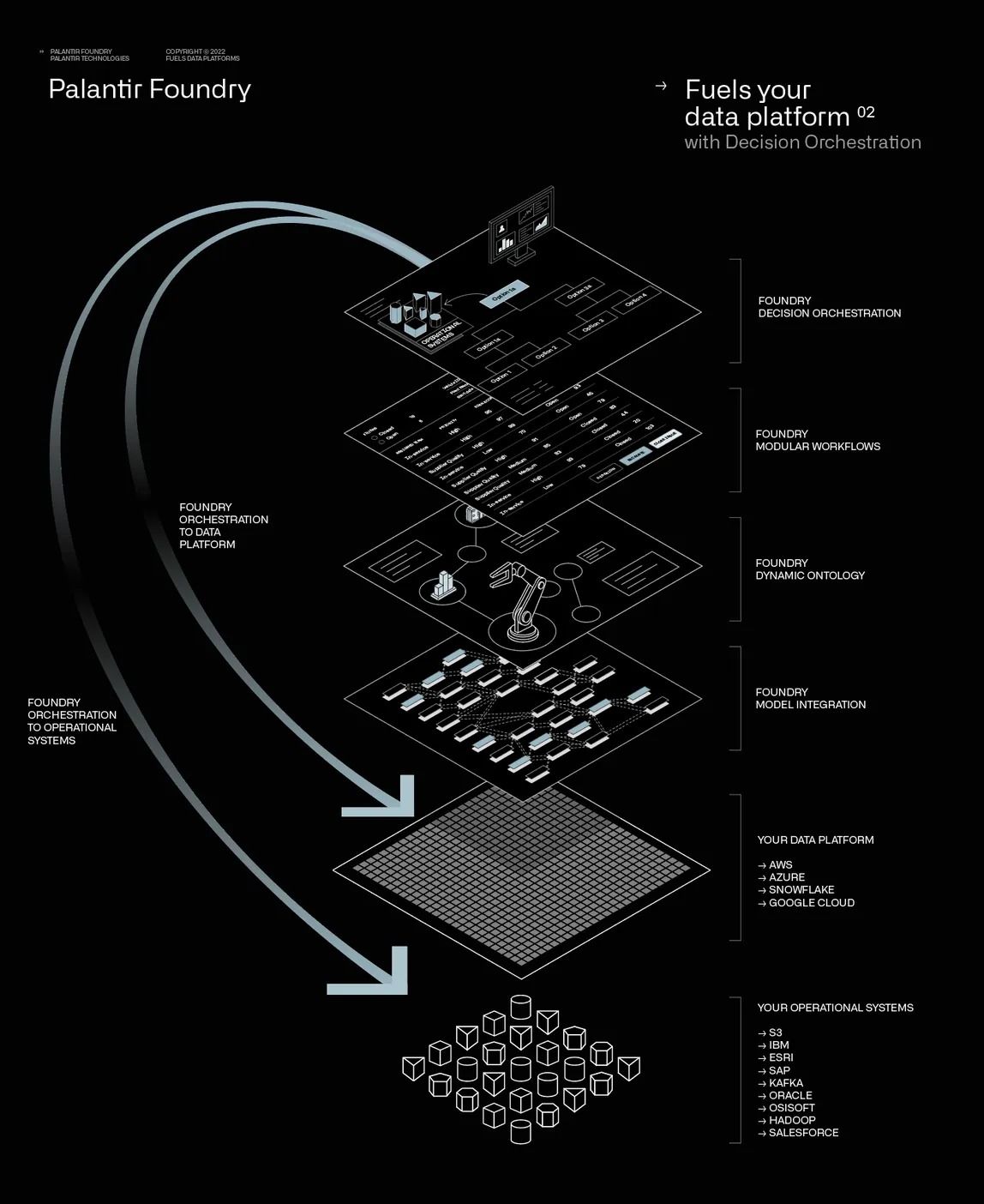
The stage first: Palantir & Foundry, the five-step loop from data to value
Palantir was founded in 2003, named after the "seeing stones" of The Lord of the Rings; in 2005 it became a software vendor for the CIA. Two core platforms: Gotham (government/defense, logic of "finding the dot"—discovering hidden relationship networks in call records, satellite imagery, and informant reports, the O-R-E model) and Foundry (commercial enterprises, logic of "modeling"—forging messy data into standardized assets, the Object/Link/Action/Function model).
The enterprise-OS trio
- FoundryThe kernel (data and operations)—Ontology is its "object model"
- AIPThe AI runtime (the star of Section 4)
- ApolloThe update mechanism—the first two total 300+ microservices on an auto-scaling compute mesh, orchestrating tens of thousands of releases weekly
The ontology (MODEL) is the hub of this chain—and it, in turn, is built from three layers (next page).
Three-layer architecture = three questions that build on each other
The semantic layer answers "what the world is" (cures data you can't understand), the kinetic layer answers "what can we do" (cures data you can't use or change), the dynamic layer answers "how the world evolves" (cures the rip-and-rebuild at scale).
Semantic layer: every entry in the "living dictionary" carries type, constraint, and permission
Foundry's type system splits into two families: Ontology types (object/property/shared property/link/action/interface) handle domain modeling; Data types (field/base/value types) handle value representation—semantics borrowed directly from the RDF/OWL/XSD Semantic Web standards.
- Type ≠ instanceAn object type is pure metadata with no data values—
Airportis a type,JFKis an instance; a link type is a relationship schema, a link is the single row "Melissa Chang → Acme, Inc." (official analogy: one row after joining two datasets) - Shared property"Created time/status/priority" defined centrally, referenced in many places, change once syncs all—DRY realized at the type-system level
- InterfaceA contract sliced by capability:
Inspectable,SchedulableResource—an interface-facing scheduling flow applies unchanged to meeting rooms, venues, vehicles (composition over deep inheritance). Interfaces can define Actions, but only edit shared properties, and no Action may change a primary key - Value typeWraps a string into "email address/UUID" with constraints attached—"age > 0" becomes a reusable asset
- Reflexive relationOn
Employee, "direct report ↔ manager"—org hierarchies and BOM parent-child parts all rely on it
Derived properties act only on directly linked objects: a one-hop-away aggregation like Budget→Customer→Orders can't be derived directly—write a Function to do an "internal hop," or denormalize moderately. Community consensus: business semantics first, flatten moderately for high-frequency display scenarios.
"Living" isn't magic, it's pipelines
| Dimension | Semantic layer (graph model) | Traditional DB schema |
|---|---|---|
| Data sync | Real-time dynamic projection, underlying changes reflected instantly | Static definition, relies on batch ETL sync |
| Flexibility | Easy to modify and extend, decoupled from storage | Very high change cost, possible service downtime |
| Data shape | Unified relational graph model | Scattered tables, relations exist implicitly |
- Each object type has a backing data source: batch pipeline / stream pipeline (low latency) / direct connect; the data source for many-to-many links attaches to the link type itself
- Incremental indexing (on by default in OSv2) processes only changes—the engineering meaning of "the model reflects underlying changes instantly"
- Security is part of the type system: MDO multi-source data objects (column-wise like a join: contact info from a public directory, salary from a controlled HR base, split at property level; row-wise like a union: each region supplies its own rows); restricted views do row-level permissions and inherit to object instances—at a cost: strictly read-only, can't be a downstream input, no external sync
So business users can ask directly: "average vibration of equipment with status 'awaiting repair' at the 'Shanghai plant' over the past 24 hours"—the system parses objects, conditions, and aggregation automatically.
Kinetic layer: where it truly parts ways—"read-only model" becomes "executable model"
Officially, ontology elements split into semantic elements ("what it is") and kinetic elements ("what it can do"). Traditional data models have only the former. The core is the Action Type: Equipment.CreateMaintenanceTicket, Transaction.ApproveTransaction.
① ACID transaction guarantee
All succeed or all roll back, no intermediate state. OSv2 gives "batch" a definite boundary: a single Action edits at most 10,000 objects.
② Bidirectional mapping (SAP as example, quite concrete)
Write-back runs through a remote-enabled function (usually a BAPI); user-driven write-back goes through the OAuth 2.0 authorization code flow—every operation on the SAP side is attributed to a specific user, so security, license compliance, and audit all hang on that attribution. Reverse read-sync relies on the SLT replication server for CDC: full load first, then only capturing increments, without hitting the production system.
③ Permissions · audit · lineage
RBAC + ABAC fine-grained permissions (ApproveTransaction may be visible only to "finance manager"); immutable audit log (who, when, what parameters, success/failure); auto-generated data lineage.
Four trigger types
- Property changeEquipment temperature exceeds 80℃
- Function resultRisk score exceeds 90
- Scheduled2 AM daily
- ManualAgent clicks "Create ticket"
The driving logic is full-spectrum
Business rules, traditional ML models, optimizers, LLMs, cross-engine chained computation—all can plug in as a Function (server-side form Functions on Objects, written in TypeScript/Python).
Between "analyzing which equipment needs repair" and "dispatching a ticket with one click," that manual fault line disappears.
Dynamic layer: let the system "grow itself", not "rip and rebuild"
The curse of traditional systems: GB grows to PB, 10 users grow to 100,000, the architecture buckles and can only be rebuilt from scratch. The dynamic layer is the adaptive-evolution layer born to break that curse—both an immune system (resisting change) and an evolution engine (driving change).
Manages four things
- Ontology iterationAuto- or semi-auto-updates the semantic layer from data/feedback/business changes—spot a frequently searched "long-tail" field, suggest promoting it to a standard property
- Action optimizationFind 90% of approvals pass via one role → suggest "auto-approve"; run root-cause analysis on frequently failing actions
- Rule evolutionMine new patterns from history to generate alerting rules, adjust thresholds dynamically by season
- CompatibilityThe lifeline: version coexistence, auto-migration, deprecation warnings, canary release
Sounds like a vision? The product has concrete counterparts
- Global Branching handles structural evolution: schema changes (adding object types, altering property definitions) branch first, test in isolation, merge to trunk after validation—zero downtime; the complementary "Scenarios" handle sandbox what-ifs at the data level
- Schema migration: after OSv2 supports breaking changes, it migrates existing user edits over rather than discarding them
- Versions record "semantic state" rather than row-level snapshots: relation establishment and dissolution, entity-identity merge and split, confidence updates. In the defense ontology, every assertion carries a standardized 1–5 confidence level + source system + report location and timestamp—so you can "return to any point in time and see what was known then," the foundation of decision traceback and audit compliance
The ontology goes from a static model needing manual maintenance to a self-evolving "living digital twin."
Five atomic elements, and the misconception to watch most: an Object is not a MySQL table
- ObjectBusiness "noun":
Customer,Equipment - PropertyObject "trait":
name,temperature - LinkObject "relation"—a graph-database edge, not a foreign key: an independent edge set, dynamic additions, ad-hoc associations, multi-hop traversal. "Leah Dou's dad's ex-wife's ex-husband"—foreign-key JOINs collapse, graph edges are a native operation
- FunctionObject "compute capability"—compiled to an AST scheduled by a built-in rule engine; three triggers (On-Change / On-Query / Scheduled); results cached as "virtual properties," invalidated automatically when a dependency changes. E.g.
fault risk score = live temperature×0.6 + maintenance-overdue penalty×0.4 - ActionObject "behavior capability"—must attach to an object, triggered most often by Function results; typical chain Property → Function computes risk → hits threshold → Action; every execution enters the "action execution timeline table," fully auditable
What ties every instance together is the RID (Resource Identifier): each row gets a globally unique, lifelong-immutable RID; links form edges via source/target RIDs; an "object set" is essentially a group of RIDs—static ones store a primary-key list, dynamic ones store a filter (new data matching is auto-included), and ad-hoc object sets expire in 24 hours.
Official breakdown: Language / Engine / Toolchain, six microservices, one set of hard numbers
Officially it's "not a thin semantic layer, but a multimodal system of dozens of underlying components." Separating read and write paths isn't a quirk of the diagram—it's the foundation OSv2 stands on.
- LanguageDeclarative modeling language: semantic objects/links/properties (nouns), kinetic actions/automations (verbs), plus logic fragments for how actions execute
- EngineThe runtime. Read: high-scale SQL, real-time state subscription, hybrid human-machine materialization; write: atomic durable transactions, bulk edits, stream processing, CDC mirroring external systems at ultra-low latency
- ToolchainOSDK (programmatic access in TypeScript/Python/Java) + DevOps tools for production-grade governance
OSv1 → OSv2: the backend itself once "rebuilt from scratch"
- OSv1 (Phonograph): a monolith coupling indexing/query/edit, low scale ceiling—exactly proving the problem the dynamic layer solves
- OSv2 rebuilt from first principles: indexing and query subsystems decoupled, each scaling horizontally; OSv1 was deprecated on 2026-06-30, existing loads need the official migration tool to move to v2
| OSv2's generational numbers | |
|---|---|
| Incremental index | On by default (processes only changes, no full re-index) |
| Scale | Tens of billions of objects per type · up to 2,000 properties per type |
| Batch boundary | A single Action edits at most 10,000 objects |
| Permissions | Object-level → property-level (basis of MDO) · native streaming low-latency index |
| Search Around | Multi-hop expansion runs on Spark, default 100,000-object cap |
Materialize, not virtualize: a well-reasoned architectural tradeoff
The intuitive answer is virtualization: keep data in place, federate at query time (Timbr compiles ontology modeling into optimized SQL pushed down to source DBs; dbt MetricFlow and Cube are also read-only logical layers generating SQL at query time). Palantir chose the opposite road.
| Dimension | Virtual semantic layer (Timbr/dbt-style) | Materialized index layer (Palantir) |
|---|---|---|
| Data location | Stays in source DB, zero migration | Indexed into the object database |
| Query performance | Depends on source-DB load and optimizer | Stable low latency, decoupled from source load |
| Freshness | Real-time at query | Depends on pipeline / CDC sync frequency |
| Source failure | Query becomes unavailable too | Reads unaffected |
| Write-back | Essentially read-only | Native Action controlled writes |
| Cost | No integration step, low storage | Integration mandatory, storage doubled, lock-in deepened |
Because of that recurring word: action. Read-only can be virtual, action cannot—a controlled write path, transaction guarantees, sub-second reads, and high-frequency AI-agent access that won't crash the production ERP all demand a storage-and-index layer that calls its own shots. Virtualization optimizes the cost of "describing the world," materialization optimizes the reliability of "changing the world."
Note: PuppyGraph's characterization "heavily materialized and indexed layer" is technically accurate; the "Palantir is closed, all-or-nothing" line in Timbr materials comes from competitor marketing—one-sided, take with a grain of salt.
The prerequisite for materialization: data must get in and line up—the three moves of entity resolution
Getting in relies on hundreds of prebuilt connectors + batch/stream/CDC pipelines; lining up relies on entity resolution—merging multiple records describing the same entity across systems into a "golden record."
- Deterministic matchPrecise matching via unique IDs like ID number or employee number—100% accurate, but can't cover long-tail data lacking a unified ID
- Probabilistic matchWithout a unique ID, analyze similarity of name, address, phone (TF-IDF, cosine similarity, random forest) to compute a "same entity?" confidence score—covering deterministic matching's blind spots
- Survivorship rulesArbitration logic when the same entity's info conflicts (e.g. "trust the most recently updated system"), determining the final golden record
Defense scenarios go further
- Multi-source data objects merge a social media account, customs passport number, corporate registration record into the same
Person - Every assertion carries a 1–5 confidence level and full provenance (source system, location, timestamp)
- The unified object keeps all source links—a sanctioned entity's shell-company network spanning jurisdictions and languages surfaces automatically this way
Connectors handle "getting in," entity resolution handles "lining up," Funnel materialization handles "reading fast, writing back"—together they support the previous page's tradeoff.
Fully zero-code: build an ontology in five steps (Ontology Builder)
100% visual drag-and-drop + form config, in the order object → property → link → function → action. Business users "draw" entities and "connect" relations on the UI; the platform auto-generates metadata, builds graph nodes and edges, allocates storage, and schedules computation.
- ①Define ObjectMap the "Book" entity from
books.csv; the system auto-suggestsbook_idas the primary key - ②Add PropertyDrag fields (title, price), or add manually (stock status, enum: in stock/lent out/sold)
- ③Create LinkLink "book-author" as
written_byviaauthor_id, cardinality 1:N - ④Write Function
price × 0.8computes the virtual property "discounted price" - ⑤Create Action
Mark_As_Sold: update the database + send notification email + call/api/inventory/reduceto decrement stock
The same template reused across industries, differing in just two places
- Function complexity: conditional matching → multi-factor weighting → ML inference
- Action loop type: financial risk control is the blocking kind—"risk score > 90 and hits a sanctions list →
Block_Transaction"; power predictive maintenance is the executing kind—"fault probability > 70% → auto-create a ticket and dispatch an engineer" - HyperAuto (software-defined data integration) for structured sources like SAP/Oracle: auto-infers foreign keys, field semantics, entity boundaries, mapping into typed objects and relation edges in minutes (traditional manual work takes months); when source tables change the mapping updates incrementally—Lowe's global supply-chain digital twin grew this way
First, auto-mapping accuracy still needs human verification: cross-table computed fields and non-standard encodings must be filled in by hand. Second, "discounted price = price × 0.8" is of course zero-code, but multi-factor risk scoring and Functions calling external ML models likely still fall back to code—zero-code covers the modeling backbone, not all logical complexity. Even so the direction holds: those who understand the business are no longer bystanders but can lead the modeling directly.
An end-to-end case across all three layers: predictive equipment maintenance
See what happens in steps 5 and 6: the system doesn't just repair equipment over and over—it learns from the repair history that "this model itself is flawed," then rewrites its own model.
The two dashed lines (teal) at step ⑥
- The semantic layer grows a new property:
modelVulnerability - The kinetic layer grows a new strategy:
ProactiveReplacement—next time a similar issue is handled proactively before it erupts
OWL and knowledge graphs can describe "the equipment broke," but neither grows a new rule on its own just because it "keeps breaking lately." That is the literal meaning of "evolvable."
The semantic layer brings data alive, the kinetic layer sets it moving, the dynamic layer makes the model grow; below is the real backend of Language/Engine/Toolchain with OSv2's read/write separation and incremental indexing; below that, the tradeoff of choosing heavy materialization for the reliability of "action." It isn't "a knowledge graph plus scripts"—it reorganizes the entire data operating system.
Loop · Ontology to the LLM's rescue
From "data-driven" to "knowledge-driven": four challenges met by four solutions, OAG swaps out RAG's retrieval target, autonomy is a dial, not a switch—finally back to that transfer no one dared approve.
- Four challenges × four solutions
- ODA ontology-driven agent
- OAG mechanism
- Engineering chain & permissions
- Intercept that transfer
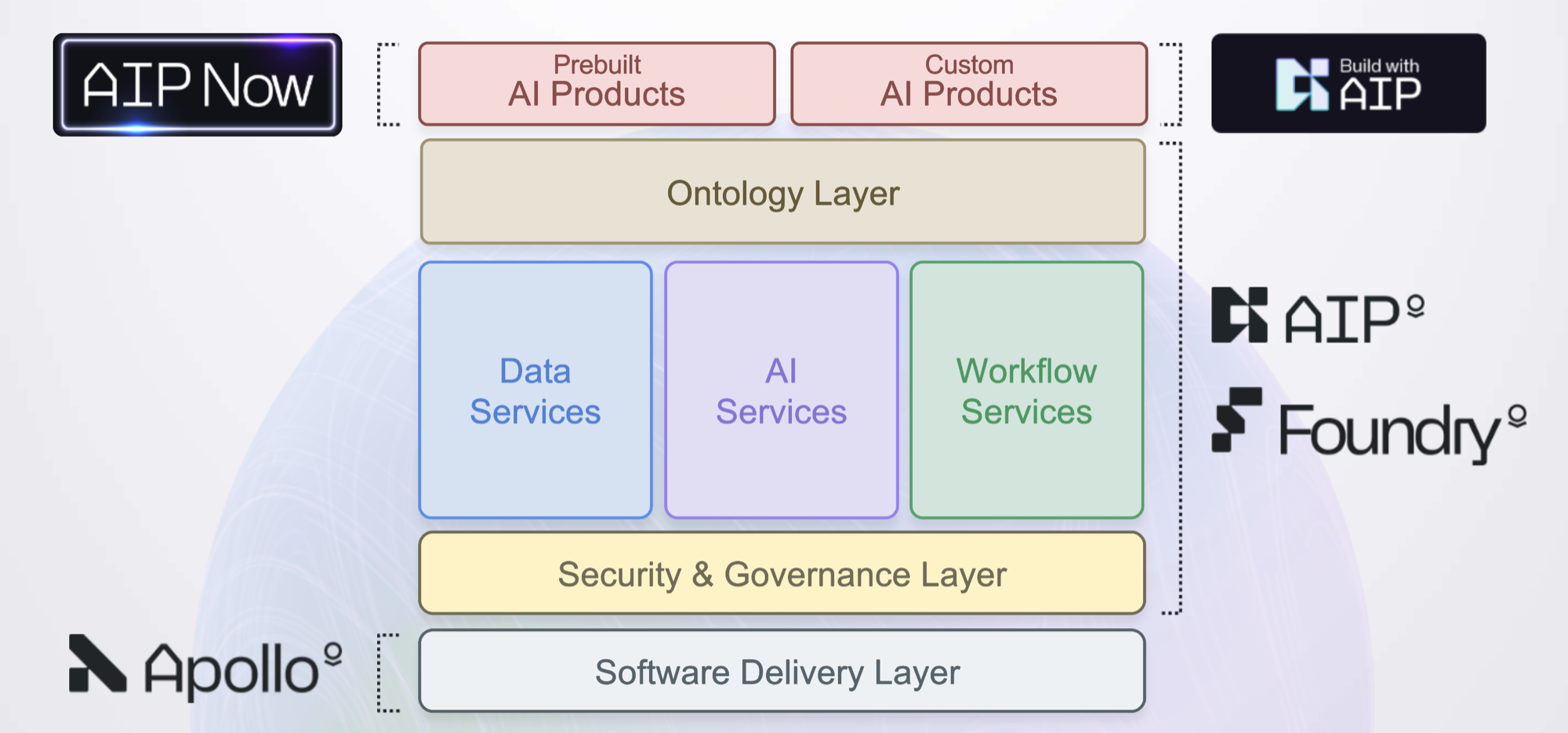
Enterprise AI's four challenges map exactly to ontology's four solutions
Traditional AI is "data-driven"—learning patterns from massive data; ontology-driven's core is "knowledge-driven"—making tacit, scattered rules explicit and structured, giving the agent a solid "worldview." The agent is no longer a black box but a navigator acting on a clear business map.
| Challenge | Symptom | Ontology's solution |
|---|---|---|
| Semantic gap | The same concept is expressed differently in ERP/MES/CRM | Unified semantic "translation layer": all map to standard ontology entities |
| Model hallucination | Random generation, black-box reasoning, may "confidently" break rules | Hard business constraints + full-chain explainability: decisions must pass rule validation, traceable to specific rule nodes |
| Execution gap | "Can see it, can't act on it" | Action elements: business operations wrapped as agent-callable interfaces |
| Hard to retain knowledge | Expert experience trapped in people's heads | Tacit experience turned into a digital asset: solidified into reusable ontology rules |
| Dimension | Traditional KG | RAG | Ontology-driven agent (ODA) |
|---|---|---|---|
| Role | Passive query tool | Text generator | Business participant, executes autonomously |
| Knowledge form | Static (entities, relations) | Dynamic (real-time retrieved text) | Dynamic (entities+relations+events+logic+behavior) |
| Reasoning | Symbolic (graph traversal) | Probabilistic (LLM generation) | Symbolic + probabilistic in concert |
| Explainability | High (clear paths) | Low (generation black box) | High (traceable to ontology rules) |
| Execution | None | None | Yes (Action drives business systems) |
OAG: swap "retrieving text chunks" for "retrieving business objects"
RAG chunks documents, computes vectors, and dredges up "look-alike" text by cosine similarity; OAG (Ontology-Augmented Generation) forces the LLM to retrieve typed objects through the governed ontology. The difference lands on four mechanisms.
- ① Structured retrievalGet typed objects, deterministic property values, explicit relation edges via OSS—not similarity-ranked text fragments
- ② Schema+permission constraintsRetrieval results are trimmed by ontology schema and caller permissions. Classic RAG mishaps like "retrieving a proposal abandoned three years ago and using it as the latest plan" are structurally eliminated
- ③ Deterministic tool callsMath and optimization aren't left to the LLM to brute-force: AIP Logic identifies the subtask, calls NVIDIA cuOpt (supply-chain optimization) or Prophet (time-series forecasting) via ontology functions, and hands only verified output back to the LLM for language synthesis. The LLM is repositioned from "omnipotent reasoner" to "coordinator": task decomposition, tool orchestration, result explanation
- ④ Full provenanceEach inference traces back to specific objects, properties, and relation edges—the answer isn't "the model feels," but "here's the evidence"
Hallucination from high to low (reduced, not eliminated, the LLM is still probabilistic at heart); permissions from document-level to object/property-level; freshness from "vector-index update" to direct OSS reads; agency from "text only" to "can trigger Actions." The k-LLM architecture routes among xAI/OpenAI/Anthropic/Meta/Google/self-hosted by task complexity and governance constraints—the LLM is a swappable component, value accrues in the ontology, governance, and orchestration layers.
The full engineering chain around OAG, and "inherited permissions"
- AIP LogicA low-code LLM-function orchestrator. Input ontology objects or strings, output objects or ontology edits; write-back has two modes—auto-apply or staged for human review; can be driven on schedule/event by Automate
- AIP EvalsPulls a non-deterministic system back into engineering discipline: run the same prompt hundreds of times for statistical evaluation, test edge cases with real production data; built-in exact-match/regex/Levenshtein evaluators, complex judgment via LLM-as-a-Judge scored 1–5 against a rubric; tracks variance across runs—high variance means an unstable prompt or rubric, not allowed into production
- Agent StudioConfigure multiple specialized copilots into a coordination network, using the ontology as a safe shared exchange medium, each agent with its own domain knowledge and operating permissions
- Object monitorsContinuously evaluate object state (stock below threshold, abnormal vital signs), auto-triggering notifications and actions when conditions are met—the sentinels of the "verb" system
Agent permissions aren't a separate scheme
- Inherited from the human user's or project's permission structure: data access is governed by the same security policies as humans
- Callable logic assets are permission-constrained, the scope of action can be precisely bounded, all activity enters the telemetry log
- Official scale for the Data–Logic–Action–Security four-way integration: real-time coordination of fine-grained policies for tens of thousands of humans and agents
The Ontology models decisions, not data.
From augmentation to automation: a dial, not a switch
Tampa General Hospital's three tiers: L1 data coordination ("patient-room-bed" unified operational twin) → L2 language interface (OAG natural-language query of live state) → L3 autonomous agents (monitor, draft, coordinate, alert—leaving only final approval to humans). The companion philosophy is "staged by default": actions are staged by default for human final review; as logs and operational data accumulate, the org gradually opens trusted, well-tested flows to the automated loop—the scope of autonomy scales up or down dynamically, changes take effect instantly.
From System of Record to System of Action: the loop and its byproduct
SAP-like systems record "what happened"; this loop acts on "what to do next." More important is the byproduct: decision data—this is the full closed loop of Section 2's "linear vs. circular."
Decision data turns back into
- Fine-tuning training sets
- Objective principles in the agent's prompt
- The agent's long- and short-term memory
- Humans and agents share access, governed by the same policy
Tribal knowledge is made explicit, forming decision-centric learning: classic ontology ends once it answers the question, operational ontology turns every answer into training data for the next question.
Ontology and LLM aren't substitutes: the ontology provides determinism and constraints (structured knowledge, business rules, traceable grounds, bounding behavior), the LLM provides flexibility and generation (language understanding, in-frame planning, handling the long tail). One says "no crossing the line," the other "get it done, cleverly."
Back to that transfer: how a hard constraint stops the AI (Knora case)
The scenario is "work-order output changes require approval," logically identical to the transfer. Swap "work-order output" for "transfer amount," and the "20% threshold" for the "100k risk-control line," and you get the deliverable engineering answer to the opening question.
- The "block + stage for review" in steps ③④ isn't unique to this case—it's the same mechanism as AIP Logic's "staged for human review" write-back mode and "staged by default" philosophy
- AI can propose, but the proposal must pass the ontology's rule validation; non-compliant instructions are stopped before they land
- Every interception can answer "why"—precise to a specific rule node
The thing we didn't dare do at the start—let AI independently approve a million-dollar transfer—now has a deliverable engineering answer: not by making the model more obedient, but by structurally making it impossible to cross the line.
A final splash of cold water: cost, lock-in, and "governance has only just begun"
This is exactly what Section 1's "deliberately downplayed cost" blind spot warned us about. There's no unified ontology theory or adoption standard across the industry; most "ontology adoption" on the market falls into a few patterns: unifying data-governance definitions / static asset modeling / semantic constraints to cure hallucination / and the one to watch most—integrators riding the buzzword, reskinning old things and selling them as ontology.
Lock-in isn't a contract clause, it's an architectural property (three layers)
- The ontology can't run independently of Foundry—there's no mechanism to export and rebuild elsewhere
- Data must be materialized and integrated via Funnel—it can't merely be "referenced"
- Different ontology instances can't be linked—in a federated deployment, the supply-chain ontology's "supplier" can't connect to the finance ontology's "accounts payable"
The operational coupling that makes controlled writes, decision capture, and a unified permission surface possible is the very coupling that makes you unable to leave—when the pipeline fails, the ontology's reads and writes stop together. The moat is less AI than the integration engineering of "do brain surgery first, then grow into a central nervous system": initial modeling is painful and long, but once embedded, switching cost is so high it approaches an organ transplant.
Three honest statements
- The Hacker News jab "this is just object-oriented programming" actually nails the point—the value isn't theoretical novelty, it's depth of execution
- Going live isn't the finish line but the start: the model drifts with the business, and one change cascades across apps, functions, APIs, and agents—the day the ontology goes live is the day governance begins
- It's no silver bullet: in many scenarios, a lightweight schema plus prompt engineering is more worthwhile. Step back to see the whole elephant, so you don't mistake one leg for the elephant itself
Ontology is a hard nut to crack: it involves semantics, operations, and evolution, and long ago stopped being an academic concept sitting in papers; doing it well is a long war of attrition.
OWL lets machines understand the world,
knowledge graphs help machines retrieve the world,
and Palantir's ontology lets machines change the world within the rules you draw—
then rewrite themselves alongside it.
The direction is clear; but go in clear-eyed—carrying Section 1's four-blind-spot vaccine and Section 5's lock-in ledger.